1099 vs W-2 Take-Home Pay Calculator
Compare cash take-home, taxes, benefits, and the contractor rate needed to match a W-2 offer.
Your tax assumptions
W-2 employee offer
1099 contractor offer
Important: This tool compares financial scenarios. It does not decide whether a worker legally qualifies as an employee or independent contractor.
Annual comparison
How this calculator estimates 2026 taxes
- Federal income tax uses 2026 progressive brackets and the standard deduction for the selected filing status.
- W-2 FICA uses 6.2% Social Security up to the $184,500 wage base plus 1.45% Medicare and applicable Additional Medicare tax.
- 1099 self-employment tax uses 92.35% of net business profit, the Social Security wage cap, Medicare tax, and the deductible half of regular SE tax.
- State/local tax is a simplified editable percentage, not a state-specific return calculation.
- Cash take-home excludes retirement contributions; total economic value adds owned retirement contributions back and includes entered employer benefits.
- Credits, itemized deductions, local rules, AMT, QBI eligibility limits, and many special tax situations are outside this estimate.
For educational planning only. Results are estimates, not tax, legal, accounting, employment, or financial advice. Tax rules and individual circumstances vary. Verify important decisions with a qualified professional.
1099 vs W-2 Take-Home Pay Calculator 2026
Choosing between a W-2 job and a 1099 contract is not as simple as comparing a salary with an hourly rate. A contractor may receive a larger payment but still keep less after self-employment tax, health insurance, business expenses and unpaid time off. A W-2 employee may receive a lower headline rate but gain paid leave, employer payroll-tax contributions and valuable benefits.
Use the 1099 vs W2 calculator above to compare both offers on the same basis. It estimates cash take-home pay, taxes, work-related costs and benefits, then shows the contractor rate needed to match the W-2 package. Enter your actual offer details instead of relying on a general rule such as “charge 30% more.”
Quick answer: A 1099 offer usually needs a higher gross rate than a comparable W-2 offer because the contractor pays both sides of Social Security and Medicare taxes and replaces employee benefits. The required premium is different for every worker, which is why a personalized calculation is more useful than a fixed percentage.
What Does the 1099 vs W2 Calculator Compare?
The calculator compares two different views of compensation.
Cash take-home pay is the estimated amount left after applicable taxes, employee deductions, contractor expenses and out-of-pocket costs. This is the money available for normal spending or saving.
Total compensation value adds benefits that may not appear in a paycheck, such as employer health-insurance contributions, retirement matching, bonuses and paid time off. These benefits are not cash in your bank account, but they can make a W-2 offer significantly more valuable.
Depending on the information entered, the tool may compare:
- W-2 salary and bonus;
- 1099 hourly rate and estimated annual billings;
- federal income-tax estimates;
- employee FICA versus self-employment tax;
- estimated state or local income tax;
- health-insurance costs;
- retirement contributions and employer match;
- paid vacation, holidays and sick leave;
- contractor business expenses;
- billable hours, working weeks and unpaid downtime;
- annual, monthly and effective hourly take-home pay; and
- the break-even 1099 rate needed to equal the W-2 offer.
The result is an estimate for planning—not a tax return or a worker-classification decision.
How to Use This 1099 vs W2 Take-Home Pay Calculator
Start with the basic figures from both offers. Enter the annual W-2 salary and the contractor hourly rate. For the 1099 side, use realistic billable hours and working weeks. A full-time contractor may work 40 hours per week but bill fewer hours because administration, client acquisition, bookkeeping and training are often unpaid.
Next, choose your filing status and enter the state-tax information requested by the tool. Add known business expenses and the amount you would pay for health coverage as a contractor. If the W-2 employer offers retirement matching, subsidized insurance or paid leave, include those items in the advanced comparison.
Review these outputs separately:
- Estimated cash take-home: Which option may leave more spendable money?
- Benefits-adjusted value: Which package may be worth more after noncash compensation?
- Break-even contractor rate: What hourly rate would make the 1099 offer competitive?
- Required rate increase: How much more would the client need to pay?
Do not compare the contractor’s gross invoices with the employee’s net paycheck. That comparison ignores the taxes and costs the contractor must pay later.
1099 vs W-2: What Is the Difference?
A W-2 worker is an employee. The employer generally withholds income tax and the employee’s share of Social Security and Medicare taxes from each paycheck. The employer also pays its own share of payroll taxes and may provide benefits such as health insurance, paid leave, retirement matching, workers’ compensation and unemployment coverage.
A 1099 independent contractor operates as a self-employed business for tax purposes. The client generally pays the contractor without withholding payroll or income taxes. The contractor is responsible for eligible business expenses, tax planning, recordkeeping and estimated payments. Contractors may have more control over how they work, but a contract label alone does not determine legal status.
| Comparison | W-2 employee | 1099 contractor |
| Tax withholding | Usually handled through payroll | Usually handled by the contractor |
| Social Security and Medicare | Employee pays one share; employer pays another | Contractor generally pays both portions through self-employment tax |
| Business expenses | Often paid or reimbursed by employer | Usually paid by contractor and may be deductible if eligible |
| Paid leave | May be included | Usually unpaid |
| Health insurance | May be employer-subsidized | Usually purchased independently |
| Retirement | May include employer match | Contractor funds own plan |
| Income stability | Often more predictable | May depend on billable work and contract gaps |
| Work control | Employer generally has greater control | Contractor generally has greater independence |
How W-2 Take-Home Pay Is Calculated
W-2 take-home pay begins with salary and taxable bonus income. The calculator then estimates payroll taxes, federal income tax and any entered state-tax amount. Pre-tax employee deductions and out-of-pocket benefit costs may also reduce current cash pay.
Employees generally pay 6.2% Social Security tax up to the annual wage base and 1.45% Medicare tax, subject to special rules for higher earners. The employer normally pays a corresponding employer share. The employer payment does not appear as extra salary, but it is a cost the worker does not have to fund personally.
For federal income tax, a reliable comparison should use progressive tax brackets rather than applying one flat rate to all earnings. A marginal bracket applies only to the portion of taxable income within that bracket. It does not mean every dollar of income is taxed at the highest rate reached.
For tax year 2026, standard deductions and bracket thresholds vary by filing status. The calculator should apply the selected filing status and current tax-year settings. Actual tax may differ because of dependents, credits, itemized deductions, other income and adjustments not entered in the tool.
How 1099 Take-Home Pay Is Calculated
The 1099 calculation starts with estimated annual contractor revenue:
Hourly rate × billable hours per week × working weeks per year
Eligible business expenses are then subtracted to estimate net business profit. Expenses may include software, equipment, professional insurance, accounting, advertising, licenses, business use of a phone or internet connection, and other ordinary and necessary costs.
Self-employment tax is not simply 15.3% of gross invoices. The IRS method generally applies the self-employment tax calculation to 92.35% of net earnings from self-employment. The 15.3% rate consists of Social Security and Medicare components, and the Social Security portion is limited by the annual wage base. One-half of self-employment tax is generally deductible when calculating adjusted gross income. See the IRS explanation of self-employment tax.
Federal income tax is calculated separately. State and local taxes may also apply. After estimated taxes, business expenses, insurance and other selected costs, the calculator produces an estimated contractor take-home amount.
Why a 1099 Rate Usually Must Be Higher Than W-2 Pay
The contractor premium must replace more than the employer share of payroll taxes. It may also need to cover:
- health, dental and vision insurance;
- unpaid vacation, holidays and sick days;
- retirement contributions and a lost employer match;
- accounting and tax-preparation costs;
- equipment, software and business insurance;
- marketing, proposals and administrative time;
- gaps between projects;
- professional training and licenses; and
- the risk of delayed or unpaid invoices.
This is why multiplying a W-2 hourly equivalent by 1.075 or adding only 7.65% is usually incomplete. That adjustment may address part of the payroll-tax difference, but not lost benefits or non-billable time.
Some comparisons use a 25% to 40% contractor premium as a starting point. It can be a useful screening rule, but it is not a personalized answer. A worker with employer-paid family health coverage and six weeks of paid leave may need a much larger premium than someone with coverage through a spouse and minimal benefits.
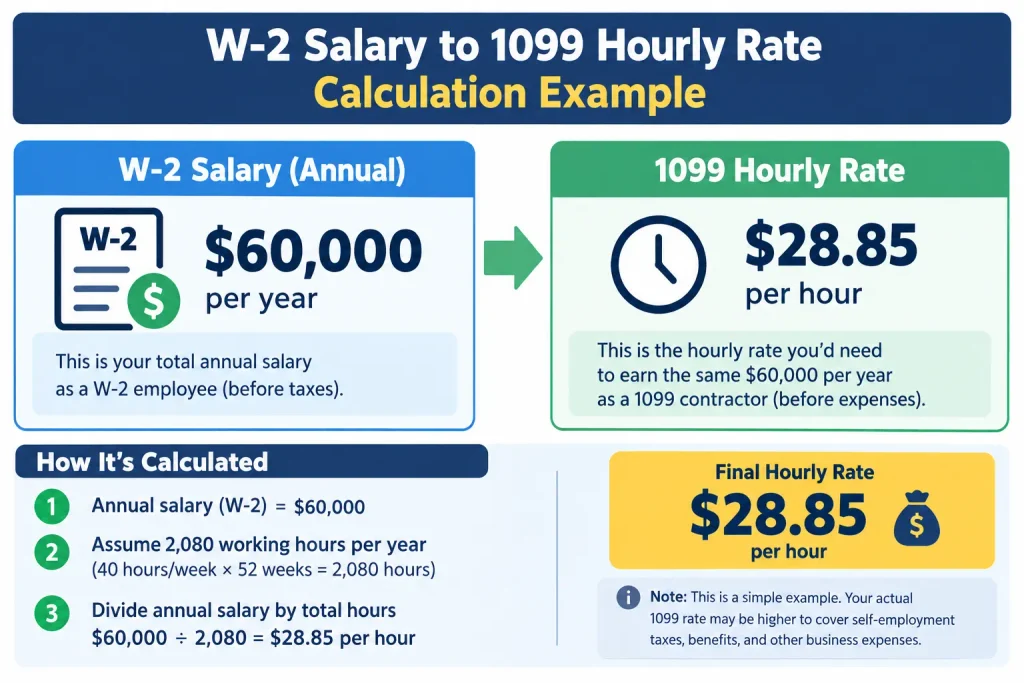
How to Convert a W-2 Salary to a 1099 Hourly Rate
First, estimate the W-2 package’s total value:
Salary + bonus + employer retirement match + employer benefit contributions + other employer-paid value
Next, estimate realistic annual contractor billable hours:
Billable hours per week × working weeks per year
Then add the contractor’s annual business costs, insurance costs and required tax/uncertainty buffer. Divide the required contractor revenue by annual billable hours.
Illustrative example
Assume one offer provides a $100,000 W-2 salary. The employer also provides a $4,000 retirement match, $8,000 of estimated health-plan value and paid leave. A competing 1099 offer pays $65 per hour for 40 billable hours over 48 weeks, producing potential gross billings of $124,800.
| Item | W-2 offer | 1099 offer |
| Headline annual pay | $100,000 | $124,800 |
| Employer benefits | Included if offered | Usually self-funded |
| Paid nonworking time | May be included | Usually not billed |
| Business costs | Often employer-paid | Contractor-paid |
| Payroll/SE tax structure | Shared FICA structure | Self-employment tax structure |
The contractor offer is 24.8% higher in gross dollars, but that does not automatically make it better. The answer depends on insurance costs, business expenses, tax circumstances, actual billable hours and the value placed on benefits. Entering those figures in the calculator above gives a more meaningful comparison than the headline amounts alone.
Business Deductions Can Improve 1099 Take-Home Pay—but They Are Not Free Money
An eligible business deduction reduces the income subject to tax; it does not reimburse the entire purchase price. If a contractor spends $1,000 on necessary software, the business has still spent $1,000. The tax saving is only the reduction created by deducting that cost under the applicable tax rules.
Potential deductions may include qualifying home-office costs, business mileage, equipment, supplies, professional services, insurance and software. Eligibility and documentation matter. Personal costs do not become deductible simply because a person receives a 1099.
Some contractors may also qualify for the qualified business income deduction or deductions connected with self-employed health insurance and retirement contributions. These rules have limitations and should not be applied automatically to every user. The calculator therefore provides a planning estimate rather than promising a deduction.
If you work from home, compare the result with the Home Office Deduction Calculator. For a broader estimate of contractor taxes, use the Quarterly Tax Calculator.
Do 1099 Contractors Need to Pay Quarterly Taxes?
Many contractors need to make estimated tax payments because a client generally does not withhold tax from 1099 payments. The IRS states that individuals generally may need estimated payments when they expect to owe at least $1,000 after subtracting withholding and refundable credits, although safe-harbor and other rules apply. Review the IRS estimated-tax guidance.
The calculator’s tax-reserve result can help with cash-flow planning. A practical approach is to transfer the estimated tax portion of each client payment into a separate savings account. However, dividing an annual estimate by four does not always produce equal IRS installments because federal estimated-tax due dates are not evenly spaced and income may be seasonal.
Is 1099 Better Than W-2?
Neither status is automatically better.
A 1099 role may be attractive when the rate comfortably replaces taxes, benefits and downtime; business expenses are manageable; billable demand is reliable; and the worker values autonomy. Contractors may also have access to business deductions and self-employed retirement options that are not available in the same way to employees.
A W-2 role may be more valuable when the employer offers strong insurance, retirement matching, paid leave, steady work, equipment and employment protections. Even with a lower hourly equivalent, the employee may have higher total compensation and less financial volatility.
The best decision should consider cash, benefits, risk, flexibility and legal classification—not taxes alone.
Worker Classification Is Not Simply a Personal Choice
A company cannot necessarily turn an employee into an independent contractor by changing the agreement or issuing Form 1099-NEC. The IRS considers the actual relationship, including behavioral control, financial control and the type of relationship between the parties. Review the IRS worker-classification guidance.
Federal and state employment laws may use additional tests. If the business controls how, when and where the work is performed, supplies the tools, expects an ongoing relationship and treats the work as a key part of its regular operations, professional advice may be appropriate. This calculator compares financial scenarios; it does not determine whether a worker has been classified correctly.
FAQs: 1099 vs W-2 Calculator
Do 1099 workers pay more taxes than W-2 employees?
1099 contractors generally pay both the employee and employer components of Social Security and Medicare through self-employment tax. W-2 employees generally pay the employee portion while the employer pays its own share. Final income tax still depends on profit, deductions, filing status, credits, state tax and other income.
Do 1099 workers pay more taxes than W-2 employees?
1099 contractors generally pay both the employee and employer components of Social Security and Medicare through self-employment tax. W-2 employees generally pay the employee portion while the employer pays its own share. Final income tax still depends on profit, deductions, filing status, credits, state tax and other income.
Do 1099 workers pay more taxes than W-2 employees?
1099 contractors generally pay both the employee and employer components of Social Security and Medicare through self-employment tax. W-2 employees generally pay the employee portion while the employer pays its own share. Final income tax still depends on profit, deductions, filing status, credits, state tax and other income.
What 1099 hourly rate equals a W-2 salary?
There is no universal conversion rate. Add the value of W-2 benefits and paid leave, estimate contractor expenses and unpaid time, then divide the required annual contractor revenue by realistic billable hours. The break-even result in the calculator performs this comparison using your entries.
How much more should I make as a 1099 contractor?
A 25% to 40% premium is sometimes used as an initial benchmark, but the correct amount may be lower or higher. Health-insurance costs, employer retirement matching, paid leave, business overhead and billable capacity can change the required premium substantially.
Can I be a W-2 employee and a 1099 contractor at the same time?
Yes. A person can have employee wages and separate legitimate self-employment income. Keep clear records for the contracting activity. W-2 wages can also affect how much of the Social Security portion of self-employment income remains below the annual wage base.
Are 1099 business expenses deducted from gross income?
Eligible ordinary and necessary business expenses generally reduce net business profit. Personal expenses and unsupported costs are not deductible merely because someone performs contract work. Keep receipts, mileage logs and other appropriate records.
Does the calculator include state taxes?
The tool may provide a state-tax estimate or allow an adjustable state rate, depending on the selected options. State rules include different brackets, deductions, credits and local taxes, so the result should be treated as an estimate rather than a filed liability.
Make an Apples-to-Apples Offer Comparison
A higher hourly rate can be appealing, but gross pay is only the first number in a 1099 vs W-2 decision. Taxes, benefits, expenses, paid leave and billable capacity determine how much the work is actually worth.
Use the 1099 vs W2 take-home pay calculator above with figures from your real offers. Compare cash take-home and total compensation separately, then use the break-even contractor rate when negotiating. If the proposed 1099 rate does not replace the benefits and costs you would assume, the offer may need to be revised before it becomes financially competitive.
Methodology and Disclaimer
This page provides estimates for educational and planning purposes. Calculations may use 2026 federal income-tax settings, payroll-tax rules and user-entered state assumptions. Actual liability can differ because of credits, dependents, itemized deductions, other income, local taxes, special deductions and changes in law. Benefits are estimated economic values and are not the same as spendable cash.
This tool does not provide tax, legal, accounting, employment or financial advice and does not determine worker classification. Consider consulting a qualified professional before accepting an offer or making tax decisions.
Last reviewed: September 18, 2026
Tax year: 2026