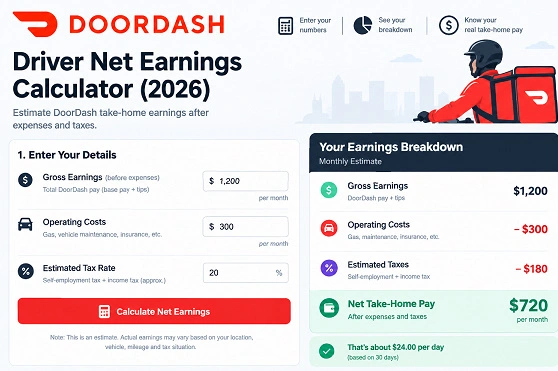
DoorDash Driver Net Earnings After Tax Calculator
Estimate what you really keep after vehicle costs, business expenses, self-employment tax, federal income tax and optional state tax.
- 2026 tax-year estimate
- No signup
- Calculations run in your browser
Calculation period
Quick earnings and work estimate
Delivery earnings
Work activity
Vehicle and mileage
You generally cannot deduct the standard mileage allowance and the same actual vehicle expenses for the same vehicle and period. Tolls and business parking remain separately deductible where appropriate.
Other business expenses
Tax profile
Your estimated DoorDash results
Earnings allocation
Earnings breakdown
| Gross delivery earnings | |
|---|---|
| Base pay | |
| Customer tips | |
| Promotions and bonuses | |
| Other delivery income | |
| Gross per delivery | |
| Gross per mile | |
| Gross per online hour | |
| Gross per active hour |
Cost breakdown
| Fuel or charging | |
|---|---|
| Maintenance and tires | |
| Insurance/business fees | |
| Tolls and parking | |
| Other business expenses | |
| Total cash operating costs | |
| Estimated depreciation | |
| Full economic cost |
Tax breakdown
| Standard mileage deduction | |
|---|---|
| Estimated actual-expense deduction | |
| Deduction method used | |
| Estimated Schedule C profit | |
| Self-employment tax | |
| Incremental federal income tax | |
| Simple state income-tax estimate | |
| Total estimated tax | |
| Effective tax rate on gross | |
| Effective tax rate on taxable profit | |
| Qualified-tips deduction used | |
| Estimated deduction-related tax savings |
Net earnings metrics
| Annual take-home | |
|---|---|
| Monthly take-home | |
| Weekly take-home | |
| Per-shift take-home | |
| Net per delivery | |
| Net per mile | |
| Net per online hour | |
| Net per active hour | |
| Economic profit after depreciation | |
| Miles per delivery | |
| Cash cost per mile |
Break-even target
| Required gross per online hour | |
|---|---|
| Approx. required gross per delivery |
Tax set-aside plan
| Amount to save from each selected-period payout | |
|---|---|
| Weekly tax set-aside | |
| Monthly tax set-aside | |
| Estimated quarterly payment | |
| Set-aside percentage of gross |
- April 15, 2026
- June 15, 2026
- September 15, 2026
- January 15, 2027
Compare a different scenario
Enter values for the same selected period used above.
How this estimate is calculated
Cash expenses reduce real take-home. Tax deductions reduce taxable business profit. The standard mileage deduction is not treated as money spent and is therefore not subtracted directly from cash take-home.
Self-employment tax applies to eligible net earnings. Federal income tax is estimated incrementally by comparing federal tax with and without DoorDash activity. The state estimate uses only the rate entered above.
A qualified-tips deduction may reduce eligible federal taxable income, but not self-employment tax. Eligibility, phase-outs, deductions, credits and actual tax liability can differ.
Your entries are calculated locally in your browser and are not sent anywhere by this calculator.
This calculator provides a planning estimate for the 2026 tax year and is not tax, legal or financial advice. Actual results can vary based on deductions, credits, state and local rules, tax-law updates and individual circumstances. Confirm important decisions with the IRS or a qualified tax professional.
DoorDash Driver Net Earnings After Tax Calculator
Your DoorDash payout is not the same as your real profit. Gas, vehicle maintenance, business expenses and taxes can significantly reduce what you ultimately keep.
The DoorDash Driver Net Earnings After Tax Calculator estimates your take-home income after subtracting operating costs, self-employment tax, federal income tax and optional state tax. It can also show your earnings per delivery, per mile and per hour.
Enter your DoorDash base pay, customer tips, promotions, mileage, working hours and expenses in the calculator above. You will receive a personalized estimate of your taxable profit, total taxes and real after-tax earnings.
This calculator is designed for US DoorDash drivers and uses estimated 2026 federal tax figures. It is a planning tool rather than a tax-return preparation service.
How to Use the DoorDash Net Earnings Calculator
Follow these steps to estimate how much of your DoorDash income you may actually keep.
1. Select your calculation period
Choose whether your figures represent:
- One shift
- One week
- One month
- One year
The calculator converts your entries into annual estimates so that federal and self-employment taxes can be calculated more accurately.
2. Enter your DoorDash earnings
Include all income earned through DoorDash, such as:
- DoorDash base pay
- Customer tips
- Peak Pay
- Challenges
- Promotions and bonuses
Do not enter the same income twice. If your DoorDash earnings statement already combines these amounts, use the total-income field where available.
3. Add your mileage and vehicle information
Enter the business miles driven while working. These may include qualifying miles driven:
- To pick up customer orders
- From restaurants to customers
- Between deliveries
- While travelling between qualifying business locations
Personal commuting and non-business driving generally should not be included.
4. Enter your actual operating expenses
Your actual costs may include:
- Gas or vehicle charging
- Maintenance and tires
- Business-use insurance
- Tolls and parking
- Delivery bags
- Phone-service business use
- Mileage-tracking subscriptions
These expenses help estimate your real cash profit.
5. Add your tax information
Select your filing status and enter other taxable income, qualified tips and an optional state tax rate. Other household income matters because it can place part of your DoorDash profit into a higher federal tax bracket.
6. Review your results
The calculator estimates:
- Gross DoorDash earnings
- Cash operating expenses
- Taxable business profit
- Self-employment tax
- Incremental federal income tax
- Estimated state tax
- After-tax take-home pay
- Net earnings per hour
- Net earnings per delivery
- Suggested tax set-aside
How DoorDash Net Earnings Are Calculated
DoorDash net earnings require more than subtracting gas from your weekly payout. The calculator separates cash expenses from tax deductions to provide a more meaningful estimate.
The simplified take-home formula is:
After-tax take-home = Gross DoorDash earnings − cash expenses − self-employment tax − federal income tax − state tax
However, taxable profit is calculated differently:
Taxable business profit = Gross business income − allowable business deductions
This distinction is important because your tax deduction may not equal the amount you actually spent.
Gross DoorDash Pay vs Real Take-Home Pay
Gross DoorDash earnings are the total amount earned before expenses and taxes. They can include base pay, promotions and customer tips.
According to DoorDash, Dasher earnings can include base pay, active promotions and tips. The company also identifies US Dashers as independent contractors rather than traditional employees. DoorDash Dasher information
Your real take-home earnings may be considerably lower than your gross payout because DoorDash generally does not deduct:
- Gas expenses
- Maintenance costs
- Vehicle depreciation
- Self-employment tax
- Federal income tax
- State or local income tax
This is why a driver receiving $25 per online hour does not necessarily have a $25 hourly profit.
Cash Profit and Taxable Profit Are Different
One of the most important concepts for DoorDash drivers is the difference between cash profit and taxable profit.
Cash profit
Cash profit measures how much money remains after actual out-of-pocket expenses:
Cash profit = Gross earnings − actual cash expenses
For example, if you earned $30,000 and spent $6,000 on gas, maintenance and other business costs, your estimated cash profit before tax would be $24,000.
Taxable profit
Taxable profit is the amount generally reported after allowable business deductions:
Taxable profit = Gross earnings − tax deductions
Suppose your qualifying standard mileage deduction and other deductions equal $12,000. Your estimated taxable business profit could be $18,000, even though your cash profit is $24,000.
The difference occurs because the standard mileage rate is a tax calculation, not necessarily the exact amount you paid for your vehicle.
DoorDash Earnings After Gas and Vehicle Costs
Vehicle costs are often a DoorDash driver’s largest operating expense.
Fuel cost
A simple fuel-cost formula is:
Fuel cost = Business miles ÷ vehicle MPG × price per gallon
If you drive 500 business miles in a vehicle averaging 25 MPG while fuel costs $3.50 per gallon:
500 ÷ 25 × $3.50 = $70 fuel cost
However, gas is only one component of vehicle ownership.
Maintenance and tires
Delivery driving can increase spending on:
- Oil changes
- Brake servicing
- Tires
- Batteries
- Repairs
- Routine maintenance
A vehicle may appear inexpensive to operate until these longer-term costs are included.
Depreciation
Depreciation represents the reduction in your vehicle’s value as mileage and wear increase. It may not leave your bank account during the current week, but it remains a real economic cost.
For this reason, the calculator can distinguish between:
- Cash take-home: excludes estimated depreciation
- Economic profit: includes estimated depreciation
DoorDash Standard Mileage Deduction for 2026
The standard mileage method allows eligible self-employed drivers to calculate a vehicle deduction using qualifying business miles.
For 2026, the business mileage rates used by this calculator are:
| Period | Business mileage rate |
| January 1–June 30, 2026 | 72.5¢ per mile |
| July 1–December 31, 2026 | 76¢ per mile |
The 2026 rate began at 72.5 cents per business mile and was increased to 76 cents for the second half of the year. IRS mileage information, SHRM midyear update
Because the rate changed during the year, an accurate calculator should ask for first-half and second-half miles separately.
For example, if a driver records 5,000 qualifying miles during each half of 2026:
- First half: 5,000 × $0.725 = $3,625
- Second half: 5,000 × $0.76 = $3,800
- Total estimated mileage deduction: $7,425
A mileage deduction reduces taxable business profit. It should not automatically be treated as an identical cash expense.
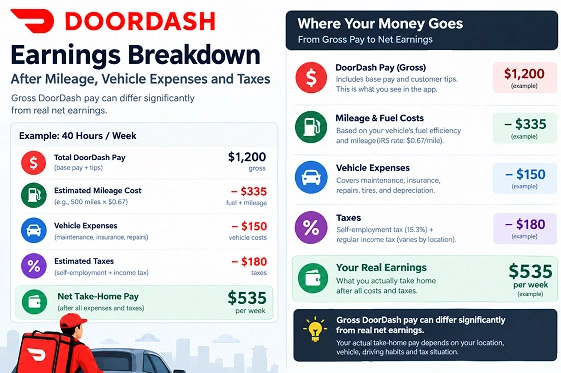
Standard Mileage vs Actual Vehicle Expenses
Eligible drivers may generally calculate their vehicle deduction using either the standard mileage method or the actual-expense method, subject to applicable rules and restrictions.
Standard mileage method
The standard mileage method uses qualifying business miles multiplied by the applicable IRS mileage rate.
This method is often simpler because the mileage rate is intended to account for vehicle expenses such as:
- Gas
- Maintenance
- Repairs
- Insurance
- Depreciation
Business parking and tolls may generally be considered separately where eligible.
Actual-expense method
The actual-expense method uses the business-use share of expenses such as:
- Gas
- Repairs
- Insurance
- Registration
- Lease payments
- Depreciation
- Maintenance
If a vehicle is used for business and personal purposes, expenses must generally be divided according to qualifying business use.
You normally cannot claim the standard mileage deduction and separately deduct the same covered vehicle costs for the same vehicle and period. Keep reliable mileage and expense records and confirm the appropriate method for your circumstances.
How DoorDash Driver Taxes Work
Dashers generally operate as independent contractors. This means DoorDash normally does not withhold federal income tax, Social Security tax or Medicare tax from payouts.
A DoorDash driver may face two major federal taxes:
- Self-employment tax
- Federal income tax
State and local taxes may also apply.
Self-employment tax
Self-employment tax generally funds Social Security and Medicare.
A simplified calculation is:
Self-employment tax base = Net business profit × 92.35%
The standard combined rate is generally:
- 12.4% for Social Security, subject to the applicable wage limit
- 2.9% for Medicare
That creates a combined basic rate of 15.3% on eligible net earnings. The calculation may change when a person also receives W-2 wages or crosses applicable Social Security and Additional Medicare Tax thresholds.
The calculator should therefore apply self-employment tax to estimated business profit—not gross DoorDash revenue.
Federal income tax
Federal income tax is separate from self-employment tax. It depends on factors including:
- Filing status
- Other household income
- Standard or itemized deductions
- Business profit
- Adjustments and credits
- Qualified-tip deduction
- Applicable federal brackets
A reliable calculator should measure how much additional federal tax the DoorDash profit could add to the user’s existing tax situation instead of applying one flat rate to all earnings.
Are DoorDash Tips Taxable?
Customer tips are normally part of a Dasher’s business income and should be included when calculating gross revenue.
A federal qualified-tips deduction may allow eligible workers, including certain self-employed individuals, to deduct up to the permitted amount of qualified tips for federal income-tax purposes. The maximum deduction is generally $25,000, subject to eligibility rules, income phase-outs and other limitations. US Treasury qualified-tips guidance
The deduction does not necessarily make tips completely “tax-free.”
In particular:
- Tips still form part of business revenue.
- Qualified tips may reduce eligible federal taxable income.
- They may remain subject to self-employment tax.
- State treatment can differ from federal treatment.
- The deduction can be limited by business profit and income phase-outs.
Drivers should therefore avoid simply removing all tips before calculating their taxes.
How Much Should DoorDash Drivers Save for Taxes?
You may see general recommendations advising Dashers to save 15%, 20% or 30% of every payout. These percentages can be useful as rough starting points but are not equally accurate for every driver.
Your appropriate set-aside depends on:
- Net profit after deductions
- Other employment income
- Filing status
- Federal tax bracket
- State income tax
- Tax credits
- W-2 withholding
- Qualified tips
- Other self-employment income
A part-time driver with high mileage and no other income may have a very different tax rate from a full-time driver who also earns substantial W-2 wages.
Use the calculator’s personalized tax-set-aside result instead of automatically applying a generic percentage to gross payouts.
Do DoorDash Drivers Need to Pay Quarterly Taxes?
The US federal tax system generally requires taxpayers to pay tax as income is earned. Independent contractors may need to make estimated payments because taxes are not normally withheld from platform payouts.
The IRS explains that estimated tax payments may apply to income not subject to withholding, including self-employment income. Individuals generally look at their projected balance due and applicable safe-harbor rules when determining whether payments are necessary. IRS estimated taxes
The standard estimated-payment dates for 2026 income are generally:
| Payment | Estimated due date |
| First payment | April 15, 2026 |
| Second payment | June 15, 2026 |
| Third payment | September 15, 2026 |
| Fourth payment | January 15, 2027 |
A deadline may change when it falls on a weekend, holiday or under an officially announced tax extension.
The calculator’s quarterly figure is a planning estimate. It does not determine whether a particular user is legally required to make estimated payments.
How to Calculate Your True DoorDash Hourly Rate
DoorDash drivers should compare both active time and total online time.
Active hourly earnings
Active time generally represents time spent completing accepted deliveries:
Net active-hour rate = After-tax earnings ÷ active delivery hours
Online hourly earnings
Online time includes the entire period spent available for work, including waiting between orders:
Net online-hour rate = After-tax earnings ÷ total online hours
For profitability decisions, the online hourly rate is often more useful because waiting time still consumes part of the driver’s day.
Example
Suppose a driver:
- Earns $200 during a shift
- Works 6 active hours
- Remains online for 9 hours
- Has $45 in operating costs
- Sets aside $35 for estimated taxes
Estimated take-home:
$200 − $45 − $35 = $120
The two hourly figures would be:
- Active-hour take-home: $120 ÷ 6 = $20
- Online-hour take-home: $120 ÷ 9 = $13.33
Looking only at active time would make the shift appear much more profitable.
Example DoorDash Net Earnings Calculation
Consider a simplified annual example:
| Item | Amount |
| Gross DoorDash earnings | $30,000 |
| Actual operating expenses | $6,000 |
| Cash profit before tax | $24,000 |
| Mileage and other tax deductions | $12,000 |
| Estimated taxable business profit | $18,000 |
| Estimated self-employment tax | $2,543 |
| Estimated federal and state income tax | $900 |
| Estimated after-tax cash take-home | $20,557 |
In this example, the driver’s tax deduction is larger than the actual cash operating cost. The $12,000 deduction is used to estimate taxable profit, while only the $6,000 actually spent is subtracted from cash take-home.
Actual results depend on mileage, expenses, other income, filing status, credits and state rules.
How to Improve DoorDash Net Earnings
Track every qualifying business mile
Mileage is often one of the largest deductions available to delivery drivers. Keep a timely record showing dates, business purpose, starting location, destination and miles driven.
Evaluate orders by dollars per mile
A high-paying order may still be unprofitable if it requires excessive mileage or leaves the driver far from an active delivery area.
Monitor:
- Gross dollars per mile
- Net dollars per mile
- Miles per delivery
- Return mileage
- Vehicle cost per mile
Measure total online time
Recording only active time can overstate hourly earnings. Include time spent waiting for orders and repositioning between delivery areas.
Separate business and personal expenses
Keep clear records and claim only the qualifying business portion of mixed expenses such as phone service and vehicle use.
Review profit weekly
Compare:
- Gross earnings
- Actual expenses
- Estimated taxes
- Mileage
- Online hours
- Net hourly earnings
This can reveal whether certain days, locations or shift times are producing better results.
DoorDash Net Earnings Calculator Limitations
This calculator provides an estimate rather than a completed tax return. It may not fully model:
- Itemized deductions
- Tax credits
- Complex QBI limitations
- Multiple businesses
- Local income taxes
- Progressive state-tax brackets
- Multi-state income
- Alternative Minimum Tax
- Special vehicle-depreciation rules
- Every qualified-tip restriction
- Changes introduced after the calculator’s last update
Consult current IRS instructions or a qualified tax professional before filing a return or making an important financial decision.
Frequently Asked Questions
How much do DoorDash drivers make after taxes?
There is no universal after-tax amount. Take-home income depends on gross earnings, mileage, vehicle costs, other deductions, filing status, additional income and state taxes. Use gross payouts, expenses and total online hours to estimate your personalized net earnings.
Does DoorDash take taxes out of driver pay?
DoorDash generally treats US Dashers as independent contractors and normally does not withhold regular payroll or income taxes from payouts. Drivers are responsible for tracking business profit and paying applicable taxes.
Can DoorDash drivers deduct mileage?
Eligible DoorDash drivers may generally deduct qualifying business mileage when using the standard mileage method. Maintain a timely mileage log and do not include personal or non-qualifying commuting miles.
Can I deduct gas and mileage together?
The standard mileage allowance generally already represents covered vehicle expenses such as fuel, maintenance and depreciation. You normally cannot claim the standard mileage deduction and separately deduct the same gas and vehicle costs for the same vehicle and period.
Are DoorDash tips subject to self-employment tax?
Customer tips generally form part of business income. Even when an eligible qualified-tips deduction reduces federal taxable income, the tips may remain subject to self-employment tax.
What is the difference between DoorDash profit and take-home pay?
Business profit is gross business income minus deductible business expenses. Take-home pay is the cash remaining after actual operating costs and estimated taxes. The two figures can differ because tax deductions do not always equal cash expenses.
Should I calculate DoorDash pay using active or online hours?
Calculate both, but use total online hours when evaluating the complete time commitment. Active hours exclude waiting periods and may make hourly profitability appear higher than it actually is.
How much should I save from each DoorDash payout?
The correct amount depends on your taxable profit, other income, filing status and state. A personalized estimate is more useful than automatically saving the same percentage of gross revenue.
Last reviewed: September 2026. This content is for general educational purposes and does not constitute tax, legal or financial advice.