


Did you know many freelancers lose hundreds — sometimes thousands — of dollars every year simply because they forget to track business mileage? 🚗💸 Whether you drive to client meetings, coworking spaces, networking events, or business errands, your vehicle expenses may qualify for valuable tax deductions. This Mileage Deduction Guide explains how freelancers, gig workers, and digital nomads can legally reduce taxes using smart mileage tracking and expense strategies.
Most independent contractors and freelancers track their software subscriptions and coffee meetings religiously, yet completely forget to log the trips they make to see clients, buy supplies, or work from co-working spaces. Vehicle depreciation, fuel, and maintenance are major business costs. This comprehensive mileage deduction guide will give you the precise blueprint needed to reclaim those lost profits and lower your tax liability.
The best part? You don’t need to be an accountant to understand it.
The Quick Answer: A Mileage Deduction Guide helps freelancers claim tax deductions for business-related driving expenses. Eligible mileage may include client meetings, deliveries, work errands, and temporary job-site travel. Keeping accurate mileage logs, using tracking apps, and separating personal and business trips are essential for maximizing deductions and staying compliant with tax regulations.
What Is a Mileage Deduction?
A mileage deduction allows self-employed professionals to reduce taxable income based on business-related vehicle use.
Instead of paying taxes on your full income, tax authorities allow you to deduct eligible driving expenses tied to business activities.
For freelancers, this often includes:
- Driving to client meetings
- Traveling to coworking spaces
- Visiting banks or post offices
- Business supply shopping
- Temporary work-site travel
What is NOT Deductible?
- The Daily Commute: The drive from your home to your permanent office space is viewed as a personal expense.
- Personal Errands: Stopping by the gym or grocery shopping on your way back from a client meeting does not qualify. The personal portion of the trip must be subtracted.
Who Can Claim Mileage Deductions?
Mileage deductions are commonly available for:
- Freelancers
- Gig workers
- Consultants
- Digital nomads
- Delivery drivers
- Real estate agents
- Small business owners
If you use your vehicle for work purposes, this Mileage Deduction Guide may help lower your tax bill significantly.
Standard Mileage vs Actual Expense Method
Most countries allow freelancers to choose between two deduction methods.
| Method | How It Works | Best For |
| Standard Mileage Rate | Deduct fixed amount per business mile | Simplicity and easier tracking |
| Actual Expense Method | Deduct fuel, insurance, repairs, depreciation | High vehicle expenses |
Example
If the standard mileage rate is 67 cents per mile and you drove 5,000 business miles:
5000 \times 0.67 = 3350
You may deduct approximately $3,350 in business mileage.
Pro-Tip: The “First Year Choice” Constraint
If you choose the Actual Expense method the very first year you use a car for your business, you are permanently locked into that method for the entire lifespan of that vehicle. If you think you might want to switch back and forth between methods later to see which yields a higher return, always choose the Standard Mileage rate in year one.
Global Frameworks: Tax Nuances Across Regions
Vehicle write-offs vary across jurisdictions. This mileage deduction guide covers specific rules for freelancers operating within the US, UK, and Canada.
🇺🇸 United States (IRS)
The Internal Revenue Service adjusts the standard mileage rate periodically to reflect inflation and fluctuating fuel costs. To use this rate, you must choose it in the first year the car is available for business use.
🇬🇧 United Kingdom (HMRC)
Her Majesty’s Revenue and Customs uses the “Approved Mileage Allowance Payments” (AMAP) scheme. The UK uses a tiered system where the rate drops after you pass a specific threshold of business miles driven within a single tax year.
🇨🇦 Canada (CRA)
The Canada Revenue Agency uses reasonable per-kilometer allowances. Unlike the US, the CRA requires a highly detailed log book displaying your odometer readings at both the start and the end of the fiscal year to claim any automobile allowances.
Regional Vehicle Allowance Comparisons
| Region | Primary Tax Authority | Standard Calculation Unit | Base Rate (Recent Averages) | Documentation Rigor |
| United States | Internal Revenue Service (IRS) | Per Mile | ~$0.67 per mile | High (Digital or written log required) |
| United Kingdom | HM Revenue & Customs (HMRC) | Per Mile | £0.45 per mile (up to 10,000 miles) | Medium (Pence per mile logs) |
| Canada | Canada Revenue Agency (CRA) | Per Kilometer | ~$0.70 per km (first 5,000 km) | Critical (Odometer start/end required) |
What Counts as Business Mileage? 🚘
Eligible Mileage
Business mileage may include:
- Client meetings
- Business networking events
- Temporary office visits
- Deliveries and pickups
- Business banking trips
- Supply purchases
Non-Deductible Mileage
Usually NOT deductible:
- Daily commuting
- School drop-offs
- Personal road trips
- Family errands
Keeping business and personal trips separate is extremely important.
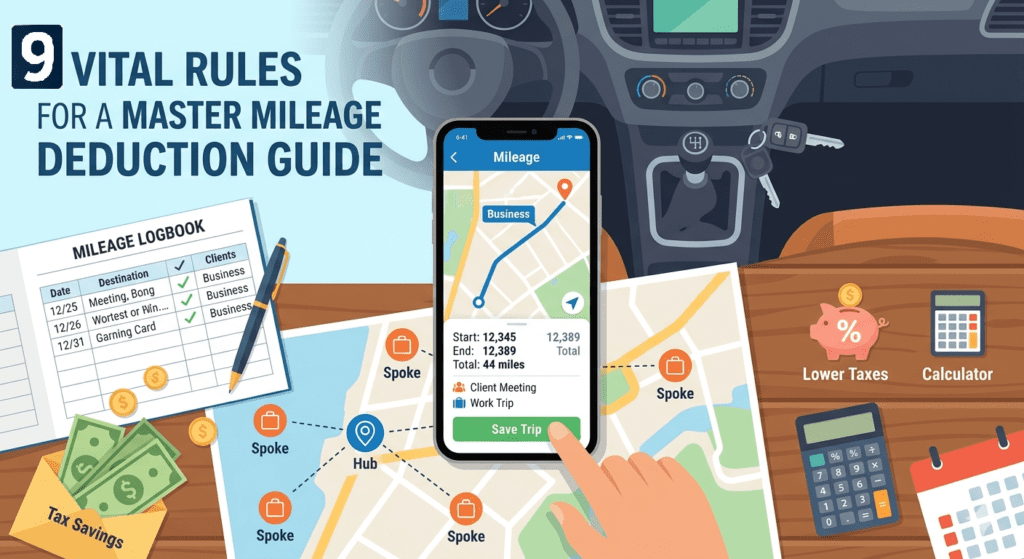
How to Track Mileage Properly
Accurate records are the foundation of any successful Mileage Deduction Guide strategy.
Essential Information to Record
Always track:
- Date of trip
- Starting location
- Destination
- Purpose of travel
- Total miles driven
Many freelancers use apps because manual tracking becomes difficult over time.
Best Mileage Tracking Apps 📱
Popular mileage apps include:
These apps automatically record trips and generate tax-ready reports.
📝 Mileage Tracking Checklist
| Task | Why It Matters |
| Save fuel receipts | Supports expense claims |
| Use mileage app | Improves accuracy |
| Separate personal trips | Prevents audit issues |
| Record trip purpose | Required for compliance |
| Backup reports monthly | Avoids data loss |
The “Hub-and-Spoke” Mileage Optimization System
Most top-ranking articles tell you to just open an app and track your drives. Here is an exclusive framework to safely maximize your travel deduction: The Hub-and-Spoke System.
To legally eliminate the non-deductible “daily commute” rule, establish a designated, exclusive home office space as your primary business hub.
When your home is officially your principal place of business, any drive you make away from your home for business reasons becomes a deductible “spoke” trip. You are no longer commuting to work; you are traveling from your office to a secondary work site. This single structural change can instantly double your legal deduction volume.
Key Takeaways
- Commuting Isn’t Deductible: Driving from home to a regular office is a personal cost unless your home is your primary office hub.
- Choose Wisely in Year One: Opt for the standard mileage rate initially if you want flexibility down the road.
- Automate the Process: Use reliable software to prevent human tracking errors.
- Keep Receipts for Actual Costs: If you reject the flat rate, every single fuel and repair invoice must be kept safe.
Unique Pro-Tip: The “Weekly Mileage Audit” System 📈
Most freelancers track mileage only during tax season — which leads to missing records.
Instead, spend 10 minutes every Friday reviewing:
- Logged trips
- Missing receipts
- Business purposes
- Mileage totals
This simple system dramatically improves deduction accuracy and reduces tax-season stress.
Mileage Deduction Example
Imagine Sarah is a freelance graphic designer.
She drives:
- 4,500 miles for clients
- 2,000 personal miles
If the IRS mileage rate is 67 cents:
4500 \times 0.67 = 3015
Sarah may deduct approximately $3,015 in business mileage expenses.
FAQs About Mileage Deduction Guide
What qualifies for mileage deduction?
Business-related driving such as client meetings, supply purchases, and temporary work trips usually qualifies.
What is the easiest mileage tracking method?
Mileage tracking apps are usually the easiest and most accurate option for freelancers.
How long should mileage records be kept?
Many experts recommend keeping mileage logs and receipts for at least 3–7 years depending on local tax laws.
Can I claim a mileage deduction if I rent or lease the vehicle?
Yes, you can use either the standard mileage rate or actual expenses for a leased vehicle. However, if you choose the standard mileage rate for a leased car, you must use it for the entire duration of the lease term.
What tracking apps are acceptable for recording miles?
Tax authorities accept digital records from dedicated mileage trackers like MileIQ, QuickBooks Self-Employed, or Hurdlr. The software must generate automated logs containing dates, locations, purposes, and total distances.
Can I deduct miles driven on a motorcycle or bicycle?
The standard mileage rate is specifically designed for cars, vans, pickups, and panel trucks. For motorcycles, specialized rates may apply depending on your local region, while bicycle deductions usually require utilizing the actual expense method for gear and repairs.
Conclusion: Stop Throwing Money Away on the Road
Your vehicle is a rolling business expense. By implementing the steps outlined in this mileage deduction guide, 🚗💰you turn regular business travel into an automated tax shield. Don’t wait until tax season to try to remember where you drove six months ago—start tracking your miles today.
Want to streamline the rest of your business finances? Head over to our detailed breakdown on how to manage freelance business receipts to keep your records audit-proof. For formal administrative standards, you can review the official IRS Instructions for Form 2106 or connect with a local accountant. 🚀