
Have you started earning money by training large language models or building custom GPT workflows, only to find yourself wondering how ai prompt engineer taxes actually work? You are not alone. As generative AI transforms the global economy, thousands of creators are pivoting into lucrative freelance AI jobs. However, with new income streams comes the reality of tax compliance.
If you are currently searching for ai prompt engineer taxes strategies, understanding self-employment rules early will help you secure your hard-earned revenue, maximize write-offs, and protect yourself against costly penalties from tax authorities like the IRS or HMRC.
Quick Answer: How Are AI Prompt Engineers Taxed?
AI prompt engineer taxes follow the standard rules established for freelancers, independent contractors, and sole proprietors. Because you do not have an employer withholding taxes from your paychecks, your net AI freelancer income is fully taxable. You must report all gross receipts, track ordinary and necessary business expenses, and pay self-employment taxes according to your local jurisdiction’s tax laws.
What Are AI Prompt Engineer Taxes?
AI prompt engineer taxes represent the legal tax obligations tied to income generated from designing, optimizing, evaluating, and consulting on AI prompts and LLM (Large Language Model) workflows.
Whether your daily operations involve tweaking context windows for corporate ChatGPT deployments, building custom prompt libraries, or providing machine learning training inputs, tax authorities view you as an independent business entity.
The mechanism through which you receive funds does not change your liability. All earnings derived from the following sources must be declared:
- Freelance Marketplaces: Upwork, Fiverr, and Topcoder.
- Direct Merchant Processors: Stripe, PayPal, and Wise.
- Direct Bank Transfers: Wire transfers and ACH payments for corporate consulting contracts.
How AI Prompt Engineers Earn Taxable Income
The rapid evolution of generative AI has created highly diversified income pipelines. To accurately calculate your tax liability, you must categorize your earnings properly.
- Freelance Prompt Engineering Contract Work: Direct fee-for-service arrangements where you build prompt templates, optimize system instructions, or orchestrate AI agent chains for clients.
- Strategic AI Consulting: High-ticket advisory services where you guide businesses on integrating AI workflows into their existing tech stacks to boost operational efficiency.
- Digital Asset Sales: Passive income earned by selling curated prompt packs, API templates, automated workflows, or educational notion databases on marketplaces like Gumroad.
- Cohort Training & Coaching: Monetizing your technical expertise by teaching enterprise teams or individuals how to effectively leverage LLMs.
Do AI Prompt Engineers Pay Self-Employment Taxes?
Yes. If you operate as a freelancer or independent contractor rather than an employee, you are responsible for calculating and paying your own social security, healthcare, and income taxes.
🇺🇸 United States
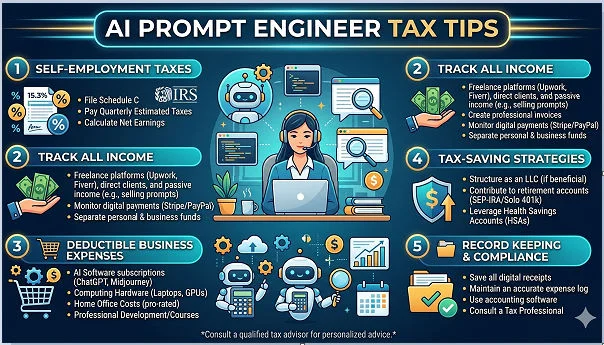
If you earn $400 or more in net freelance AI jobs revenue, you must file a Schedule C (Form 1040) to report your business profits. You will also be subject to a 15.3% Self-Employment Tax (covering Social Security and Medicare) via Schedule SE, alongside standard federal and state income taxes. Furthermore, under the latest tax guidelines, qualifying freelancers who utilize specific itemized write-offs will track their adjustments using the newer Schedule 1-A. You are typically required to make Quarterly Estimated Tax payments to avoid year-end penalties.
🇬🇧 United Kingdom
AI freelancers operating as sole traders must register for Self Assessment with HMRC once gross income exceeds £1,000 within a tax year. You will pay Class 2 and Class 4 National Insurance contributions alongside standard income tax rates.
🇨🇦 Canada
Independent AI practitioners must declare their earnings as professional income using Form T2125 (Statement of Business or Professional Activities). If your gross taxable revenues exceed $30,000 over four consecutive quarters, you must also register for and collect GST/HST.
Taxable Income vs. Non-Taxable Transactions
Distinguishing between business revenues and personal inflows prevents you from overpaying or triggering an audit.
| Transaction Type | Usually Taxable? | Real-World Scenario |
| Prompt Engineering Contract | Yes | Client pays you $2,500 to optimize a customer service chatbot. |
| Corporate Strategy Consulting | Yes | An agency pays you an hourly rate for LLM implementation advice. |
| Digital Product/Course Sales | Yes | Engineers buy your $49 Advanced Midjourney Prompt Guide. |
| Affiliate Commissions | Yes | You earn payouts for recommending an AI copywriting tool or vector database. |
| Family/Personal Gifts | No | A relative sends you cash for your birthday. |
| Business Loan Principal | No | A bank deposits a small business loan into your corporate account. |
Common Tax Deductions for AI Prompt Engineers
The most effective way to lower your ai prompt engineer taxes liability is by aggressively claiming every legitimate, ordinary, and necessary business deduction.
1. Software & API Subscriptions
As an AI professional, your digital toolkit is completely deductible. This includes premium tiers for LLMs, deployment platforms, and developer environments:
- ChatGPT Plus, Claude Pro, and Gemini Advanced.
- Midjourney, Runway, and alternative generative media tools.
- API usage fees from OpenAI, Anthropic, or Cohere used during prompt development.
- IDE tools, GitHub Copilot, and cloud hosting accounts (AWS, Google Cloud, Azure).
2. High-Performance Hardware & Equipment
Running local models or managing heavy data pipelines requires specialized infrastructure. You can write off or depreciate equipment used strictly for your business:
- High-end laptops, workstations, or dedicated GPUs (e.g., NVIDIA RTX series) used for local LLM testing.
- Ergonomic desks, chairs, 4K monitors, and external backup drives.
3. Dedicated Home Office Space
If you utilize a specific area of your home exclusively and regularly for managing your freelance AI jobs, you can claim a home office deduction. This allows you to deduct a prorated percentage of your rent, mortgage interest, utilities, and home internet costs.
4. Technical Education & Research
The pace of AI development requires continuous upskilling. You can fully deduct costs associated with staying competitive:
- Advanced prompt engineering certifications and machine learning bootcamps.
- Paid research newsletters, technical e-books, and tickets to AI conferences.
Pro Tip: The AI Revenue Tax Shield Framework
Don’t wait until April to think about your finances. Implement the AI Revenue Tax Shield Framework to permanently eliminate tax-season stress.
- Step 1: The 30% Quarantine: Open a dedicated, high-yield business savings account. Every time a client pays an invoice or a marketplace issues a disbursement, instantly move 30% of that gross amount into this account. Never touch this cash for personal expenses; it belongs to the tax collector.
- Step 2: Micro-Categorization: Implement bookkeeping software to bucket every outgoing business dollar into five core buckets: AI Tooling, Compute/Hardware, Continuous Education, Advertising, and Administrative/Legal.
- Step 3: Monthly Net Accounting: At the close of every calendar month, run a simple formula:
$$\text{Gross Revenue} – \text{Business Expenses} = \text{Taxable Profit}$$
By understanding your real-time taxable profit, you can accurately adjust your quarterly estimated tax payments.
Record-Keeping Checklist for AI Prompt Engineers
Maintain an immutable digital paper trail. If an audit occurs, documentation is your only defense.
- Archive Client Service Agreements: Retain all execution contracts detailing project scope.
- Collect 1099/Tax Forms: Secure your Form 1099-NEC (US) or platform earnings statements at year-end.
- Log Every SaaS Invoice: Set up an automated email filter to route receipts from OpenAI, Anthropic, and cloud providers to a dedicated finance folder.
- Isolate Payment Reports: Download monthly transaction summaries from Stripe, PayPal, and Wise to track platform processing fees (which are also deductible).
- Track Hardware Assets: Save digital receipts for all computer accessories and compute hardware, noting the exact date of purchase and business use percentage.
The AI Freelancer Tax Cycle Calendar
Tax Mistakes AI Prompt Engineers Should Avoid
- Co-mingling Personal and Business Assets: Using your personal credit card for business AI subscriptions creates an accounting nightmare. Establish a clean, dedicated business bank account immediately.
- Neglecting International Compliance: If you are a digital nomad or work with cross-border clients, pay close attention to local tax residency rules and withholding certificates (such as the W-8BEN for non-US citizens working with US agencies).
- Disregarding Small Inflows: Micro-consulting sessions or small custom prompt sales on alternative marketplaces must be declared. Every dollar counts toward your total gross income.
Frequently Asked Questions
Do AI prompt engineers pay self-employment taxes?
Yes. If you offer prompt engineering services as an independent contractor, freelancer, or sole trader, your profits are subject to self-employment taxes to fund social programs like Social Security and Medicare.
Can AI software subscriptions be tax deductible?
Absolutely. If you pay for ChatGPT Plus, Claude Pro, or developer APIs to build, test, and deliver client work, those costs are considered ordinary and necessary business expenses and are tax-deductible.
What records should AI prompt engineers keep?
You should systematically store digital copies of all client invoices, platform payout summaries, software subscription receipts, hardware purchases, and banking statements for at least three to seven years, depending on your local regulations.
Summary of Key Takeaways
- AI prompt engineer taxes match standard local rules for freelance and self-employed income.
- All digital asset sales, consulting retainers, and platform payouts must be tracked as gross revenue.
- AI subscriptions, cloud compute fees, and local testing hardware are fully deductible business expenses.
- The AI Revenue Tax Shield Framework prevents financial surprises through proactive 30% saving habits.
Disclaimer: This guide is intended solely for informational purposes. Tax laws vary radically by locality, state, and country. Always consult a certified public accountant (CPA) or qualified tax professional regarding your specific financial situation.
Next Steps for Independent AI Professionals
The global demand for skilled AI prompt engineers is expanding, presenting an incredible financial opportunity for technical creators and digital nomads alike. However, building long-term wealth in this industry requires a firm grasp of your fiscal obligations.
Start tracking your revenue cleanly, take advantage of the generous deductions available for technical infrastructure, and leverage our comprehensive Freelance Tax Deductions Guide to keep more of your hard-earned cash. For those taking their skills across borders, our specialized Digital Nomad Tax Guide will keep you compliant worldwide. Additionally, if you prefer using digital wallets to collect global invoice payments, don’t miss our breakdown on navigating PayPal Taxes for Freelancers to avoid common reporting mistakes.
Take control of your workflow, implement the AI Revenue Tax Shield Framework this week, and secure your freelance business long before the tax season rush.