


Written by: Mik
Reviewed by: Freelancer Finance Editorial Team
Last updated: July 2026
Freelance income rarely arrives in neat, predictable paychecks. One month may generate record revenue, while the next delivers delayed invoices, project gaps, and unexpected cash-flow pressure.
Without a structured variable income budgeting system for freelancers, even highly profitable freelance businesses can struggle to pay bills consistently, save for taxes, or plan for growth.
The goal is not to earn exactly the same amount every month.
The goal is to build a financial system that creates stability even when income remains unpredictable.
In this guide, you’ll learn a proven framework that successful freelancers use to smooth irregular income, protect tax obligations, maintain business reserves, and pay themselves a predictable monthly salary regardless of monthly revenue fluctuations.
A successful variable income budgeting system for freelancers relies on three principles:
- Separate business and personal finances.
- Create a financial buffer for slow months.
- Pay yourself a fixed monthly salary rather than spending directly from client payments.
By combining these principles with a structured bucket system, freelancers can eliminate much of the stress associated with irregular income.
Disclaimer: This article is for educational purposes only and does not constitute tax, legal, or financial advice. Always consult a qualified professional for your personal situation.
The Freelance Income Stability Framework™
This guide uses a simple framework called the BAS Method™:
Buffer → Allocate → Salary
- Buffer incoming payments inside your business account.
- Allocate funds into dedicated financial buckets.
- Salary yourself using a predictable monthly draw.
This simple process transforms unpredictable freelance revenue into a stable financial system.
Why Traditional Budgeting Fails Freelancers
Most budgeting advice assumes you receive a predictable paycheck every month.
Frameworks like the 50/30/20 rule work well for salaried employees but often fail for freelancers whose income can fluctuate by 30%, 50%, or even 70% between months.
This creates several common problems:
- Overspending during high-income months.
- Struggling to cover fixed expenses during slow periods.
- Accidentally spending money reserved for taxes.
- Making financial decisions based on temporary revenue spikes.
Freelancers need systems built specifically for irregular income rather than traditional employee budgeting methods.
Step 1: Calculate Your Baseline Survival Number
Before assigning a purpose to incoming money, determine the minimum amount required to keep your personal life and business operating.
This number is your Baseline Survival Number.
Personal Essentials
Include only unavoidable living costs:
- Housing
- Utilities
- Groceries
- Healthcare
- Insurance
- Minimum debt payments
- Transportation
Business Essentials
Include critical operating expenses:
- Software subscriptions
- Website hosting
- Accounting tools
- Internet costs
- Professional memberships
- Equipment insurance
Once combined, these expenses create your financial floor.
This is the minimum amount your freelance business must generate every month to remain healthy.
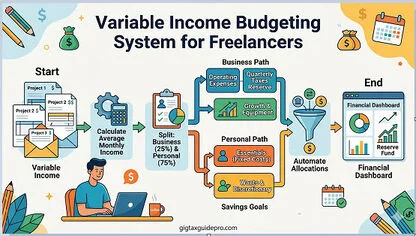
Step 2: Build the 3-Bucket Budgeting System
The biggest mistake freelancers make is treating every incoming payment as spendable income.
In reality, every client payment already has multiple owners:
- A portion belongs to tax authorities.
- A portion belongs to business operations.
- A portion belongs to future slow months.
- Only the remaining portion belongs to your lifestyle.
The solution is the 3-Bucket System.
Bucket 1: The Tax Vault
The moment a client payment arrives, immediately move 25% to 35% into a dedicated tax account.
This money no longer belongs to your business.
It belongs to future tax obligations.
Keeping taxes separate eliminates surprises and prevents accidental overspending.
Bucket 2: Business Operations
This account funds the growth and maintenance of your business.
Typical expenses include:
- Software subscriptions
- Marketing costs
- Contractors
- Education and training
- Equipment upgrades
- Insurance
This account also holds your business emergency reserve.
Bucket 3: Personal Living Expenses
This is your personal spending account.
Groceries, rent, entertainment, and lifestyle expenses should come only from this account.
Never spend directly from your business account for personal purchases.
Real Example: How the System Works
Imagine a freelance designer whose monthly income fluctuates between $2,000 and $8,000.
Instead of spending directly from invoices:
- 30% goes immediately into the Tax Vault.
- Business expenses remain in the Operations account.
- Remaining profits accumulate in a Buffer Account.
- A fixed salary of $3,500 is transferred every month to the personal account.
Even during low-income months, the freelancer continues receiving the same monthly salary because previous surplus months funded the buffer.
The result is financial stability despite unpredictable revenue.
Step 3: Implement the Monthly Salary Method
The Monthly Salary Method is often the biggest difference between financially stable freelancers and those trapped in the feast-or-famine cycle.
Instead of spending money as clients pay invoices, your business becomes responsible for paying you a predictable salary.
This approach:
- Reduces financial stress.
- Simplifies budgeting.
- Creates consistency.
- Encourages long-term planning.
Your freelance business should function like an employer.
You simply happen to be the employee.
Setting Up Your Salary
Review your average net income from the last 12 months.
Example:
- Average monthly net income: $5,000
- Baseline Survival Number: $3,500
A reasonable monthly salary may be:
$4,000–$4,200
This creates room for savings while still building business reserves.
The Rolling Runway Framework
Traditional advice recommends a personal emergency fund covering three to six months of expenses.
Freelancers need something more dynamic.
The Rolling Runway Framework transforms your cash reserve into a business management tool.
Use this formula:
Business Buffer Balance ÷ Monthly Expenses = Runway Months
Example:
- Buffer balance: $18,000
- Monthly expenses and salary: $4,500
Runway:
4 Months
How to Interpret Your Runway
6+ Months: Growth Mode
Invest in marketing, systems, and expansion.
4-6 Months: Stable Mode
Maintain current operations.
Below 3 Months: Client Acquisition Mode
Shift significant time toward sales, networking, and lead generation.
This creates an early warning system long before a financial crisis develops.
7. International Tax & Currency Nuances for Freelancers
Operating a successful freelance business looks different depending on where your clients and your primary operations are registered. If you serve an international client base, managing your variable income budgeting system for freelancers requires navigating unique cross-border compliance, localized tax systems, and currency volatility.
United States (USA)
As a self-employed freelancer in the US, you are responsible for paying the Self-Employment Tax (currently 15.3% for Social Security and Medicare) in addition to federal and state income taxes.
Because freelance income often changes from month to month, most freelancers must calculate and submit Estimated Quarterly Tax Payments using IRS Form 1040-ES. You can simplify this process by using a Quarterly Tax Calculator or reviewing our guide on How to Calculate Freelance Taxes in the USA.
Missing payment deadlines in April, June, September, and January can lead to IRS underpayment penalties and interest charges. To avoid surprises, maintain a dedicated Tax Vault and transfer a percentage of every payment you receive into it immediately.
United Kingdom (UK)
Freelancers operating as sole traders in the UK must register for the Self Assessment system with HMRC.
Taxes are typically paid through Payments on Account, with payment deadlines on 31 January and 31 July each year. This system can create significant cash flow pressure because freelancers are often required to pay part of their estimated tax bill for the following year in advance.
If your taxable turnover exceeds the VAT registration threshold, you must register for VAT and comply with quarterly reporting requirements under the Making Tax Digital (MTD) rules.
Building a dedicated Tax Vault and setting aside money throughout the year can prevent cash flow problems when these deadlines arrive.
Canada
Canadian freelancers operating as sole proprietors report business income using the T2125 Statement of Business or Professional Activities, which is submitted with their personal T1 Income Tax Return.
If your net self-employment income exceeds $3,500, you must contribute to the Canada Pension Plan (CPP) by paying both the employee and employer portions of the contribution.
In addition, if your gross taxable revenue exceeds $30,000 in a single calendar quarter or over four consecutive quarters, you are required to register for, collect, and remit GST/HST.
A common mistake among freelancers is treating GST/HST collections as business income. Instead, these funds should go directly into your Tax Vault and remain separate from operating cash and profits.
Multi-Currency Freelancers
If clients pay in USD while expenses occur in another currency, exchange rates can significantly affect profitability.
Strategies include:
- Holding part of reserves in USD.
- Converting only operational requirements.
- Monitoring exchange fees carefully.
- Using multi-currency accounts.
Common Variable Income Budgeting Mistakes
1. Lifestyle Inflation
A single large invoice does not mean your income permanently increased.
Avoid increasing fixed expenses too quickly.
2. Ignoring Small Business Expenses
Minor expenses accumulate rapidly and may be tax deductible.
Track everything.
3. Mixing Business and Personal Money
Using your business account as a personal ATM destroys financial visibility and makes tax reporting significantly harder.
4. Operating Without a Buffer
Without reserves, one late-paying client can create a financial emergency.
5. Paying Yourself Random Amounts
Irregular withdrawals create personal financial instability.
Consistency matters more than maximizing every month.
Essential Frameworks & Comparison Tools
To help you choose the right approach for your unique financial situation, use the direct comparison table below to contrast the three primary operational methods for managing variable freelance income.
| Budgeting Methodology | Ideal Client Profile | Core Advantage | Primary Risk Factor |
| Baseline Survival Method | New freelancers or those in a heavy rebuilding phase. | Guarantees all absolute essential bills are covered first. | Provides zero structural guidance for handling surplus cash. |
| 3-Bucket System | Established freelancers with regular monthly client projects. | Keeps tax liabilities completely isolated from daily lifestyle spending. | Requires active management and manual transfers. |
| Monthly Salary Method | High-earning freelancers with volatile seasonal cycles. | Delivers a highly predictable, stress-free personal lifestyle budget. | Requires a substantial initial cash reserve to set up. |
Your Variable Income Optimization Checklist
- Create separate business and personal bank accounts.
- Calculate your Baseline Survival Number.
- Route all client payments through business accounts.
- Move 25-35% of income into taxes immediately.
- Build a minimum three-month runway.
- Pay yourself a fixed monthly salary.
- Review financial performance every month.
Key Takeaways
- Traditional budgeting systems fail for irregular income.
- Separate taxes, business operations, and personal spending.
- Build a financial buffer before increasing lifestyle expenses.
- Pay yourself a predictable salary.
- Monitor your runway monthly.
- Treat your freelance business like a real business.
FAQs: Variable Income Budgeting System for Freelancers
What happens if a client pays late?
Your financial buffer should absorb temporary payment delays without disrupting your monthly salary.
How much should freelancers save for taxes?
Most freelancers should reserve between 25% and 35% of gross income depending on their tax situation and country.
Are budgeting apps necessary?
No. Many freelancers successfully manage finances using spreadsheets or simple accounting software.
How often should I review my salary amount?
Every six months is usually sufficient unless business revenue changes dramatically.
Where should I store tax reserves?
A dedicated high-yield savings account is usually the safest and simplest option.
Continue Building Your Freelance Finance System
To fully implement this framework, continue with these companion guides:
- How to Budget with Irregular Freelance Income
- Bucket Budgeting System for Freelancers Explained
- Monthly Salary Method for Freelancers with Variable Income
- Common Variable Income Budgeting Mistakes Freelancers Make
Together, these articles create a complete financial operating system for independent professionals.
Conclusion
Financial stability in freelancing does not come from earning more money.
It comes from building systems that make unpredictable income behave like a predictable salary.
The freelancers who survive economic downturns are rarely the highest earners.
They are usually the ones who separate taxes immediately, maintain healthy reserves, and pay themselves consistently through disciplined financial processes.
Build the system once, and it will continue protecting your business for years.
The goal is not to eliminate income volatility. The goal is to become financially immune to it.