

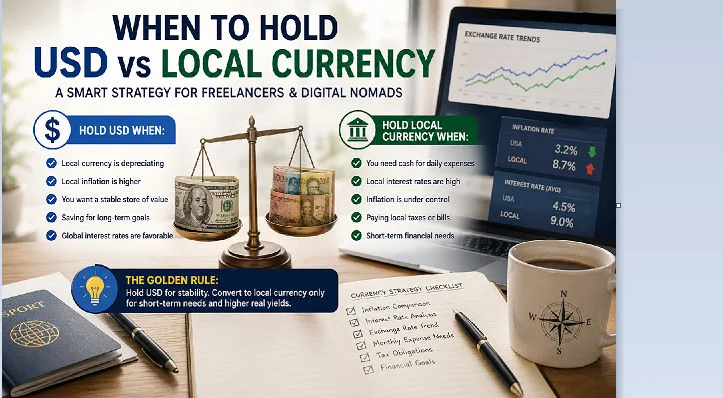
Understanding when to hold USD vs local currency is a critical financial decision for freelancers, remote contractors, and digital nomads managing cross-border income.
In practice, when to hold USD vs local currency depends on inflation trends, exchange rate volatility, and real interest rate differences between economies. Without a structured approach, freelancers lose income silently through conversion spreads and currency depreciation.
This guide breaks down a professional-grade treasury framework that helps you decide exactly when to hold USD vs local currency using macro signals, cash flow rules, and risk-based allocation logic.
The Core Principle: Currency Is a Risk Asset
Before deciding when to hold USD vs local currency, treat both as risk-adjusted financial instruments:
- USD = global reserve stability asset
- Local currency = spending + yield optimization asset
Your goal is not prediction — it is structured allocation based on economic conditions.
Direct Answer: When to Hold USD vs Local Currency
You should hold USD when:
- Local currency is depreciating against USD
- Inflation is higher locally than in the US
- You need long-term purchasing power protection
- Global risk or volatility is increasing
You should hold local currency when:
- Domestic interest rates offer strong real yields
- Currency is stable or strengthening
- You have near-term local expenses or tax obligations
👉 In short:
USD protects value. Local currency optimizes yield.
The 4-Key Decision Drivers
1. Inflation Differential
If local inflation exceeds US inflation → USD becomes stronger in real value.
2. Interest Rate Spread
Compare:
- USD savings yield (e.g., US T-bills / HYSA)
- Local fixed deposit returns
Only hold local currency if real yield is positive.
3. FX Trend Momentum
- Downtrend in local currency → accumulate USD
- Stable range → partial conversion strategy
4. Cash Flow Timing
Always prioritize:
- 30-day operational needs
- Tax obligations
- Emergency liquidity
Multi-Currency Treasury System (Professional Framework)
Instead of reacting emotionally, use this structured allocation model:
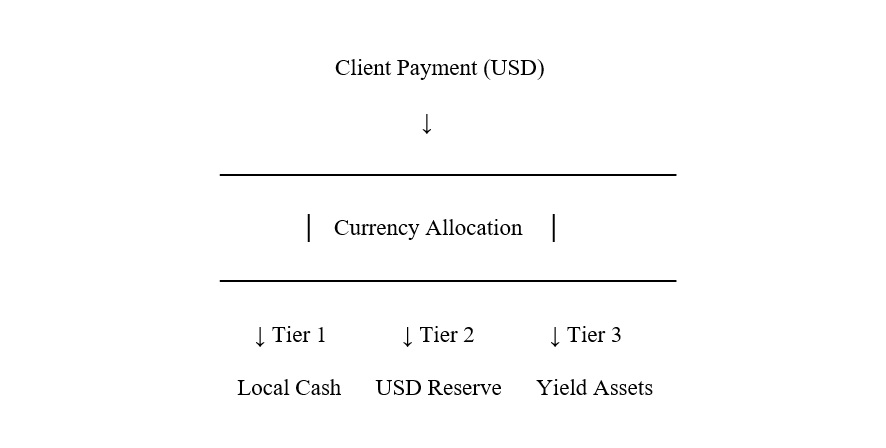
Tier 1: Local Operating Cash
Used for:
- Rent
- Food
- Utilities
- 30-day expenses
Rule:
👉 Convert only what you need for the next 30 days.
Tier 2: USD Stability Reserve
Used for:
- Savings protection
- Emergency funds
- FX hedge layer
Rule:
👉 Keep core savings in USD during uncertainty cycles.
Tier 3: Yield Optimization Layer
Used for:
- High-interest accounts
- Treasury instruments
- Investment capital
Rule:
👉 Choose currency with highest real yield (interest − inflation)
Real Yield Formula (Critical Insight)
\text{Real Yield} = \text{Nominal Interest Rate} – \text{Inflation Rate}
Key Insight:
Nominal returns are misleading — real yield determines true wealth growth.
Currency Allocation Decision Matrix
| Condition | Hold USD | Hold Local Currency |
| High inflation locally | ✅ | ❌ |
| Strong USD trend | ✅ | ❌ |
| High local interest rates | ❌ | ✅ |
| Immediate expenses | ❌ | ✅ |
| FX volatility rising | ✅ | ❌ |
Use this definitive metric matrix to evaluate your portfolio balance whenever you determine when to hold USD vs local currency:
| Financial Indicator Metric | Action: Retain US Dollar (USD) | Action: Convert to Local Currency |
| Local Inflation Trend | Rising rapidly or outstripping US metrics | Stable, low, or tracking below US metrics |
| Domestic Interest Rates | Low, stagnant, or negative when inflation-adjusted | High real yields that outpace domestic currency drops |
| 30-Day Cash Outflows | Exceeds immediate operational demands | Required immediately to settle local operational costs |
| Tax Liability Profile | Cross-border obligations or dollar-denominated fees | Immediate domestic quarterly tax settlement dates |
| Macro Forex Trajectory | Local currency is depreciating against USD | Local currency is showing sustainable structural strength |
Q: Should I convert USD to local currency now?
Only convert if you need short-term spending liquidity. Otherwise, keep USD during inflation or currency depreciation cycles.

Regional Strategy Insights
🇺🇸 US-Based Freelancers
Keep USD as base currency. Convert only for international expenses.
🇬🇧 UK Freelancers
Hold USD reserves if GBP is volatile or client income is USD-heavy.
🇪🇺 Eurozone Freelancers
Maintain USD buffer to hedge ECB-driven volatility cycles.
🇨🇦 Canada
Use USD reserves when CAD weakens due to commodity cycles.
Advanced Rule: Monthly FX Conversion Cycle
Instead of reactive trading:
👉 Convert only once per month
👉 Cover 30-day expenses + 10% buffer
👉 Keep remainder in USD
This reduces:
- FX spread losses
- Emotional decision-making
- Timing risk
Key Takeaways
- Protect Assets in USD: Use US Dollars as your primary defensive currency if your domestic currency faces high inflation or downward market pressure.
- Convert Only for Short-Term Needs: Limit local currency transfers to the exact amounts needed for immediate 30-day operating costs and regional tax bills.
- Analyze Real Yields: Always subtract local inflation from nominal interest rates before moving your savings into high-yield local bank accounts.
- Consolidate Inbound Funds: Route incoming client payments into USD accounts first to avoid automated, expensive bank conversion fees.
- Keep Regular Logs: Use reliable free budgeting apps for freelancers to track your cross-border profits and transaction expenses closely.
Frequently Asked Questions (FAQs)
Is it safe to leave my international freelance earnings sitting inside PayPal?
No, it is highly risky to use payment processors as long-term storage accounts. Platforms like PayPal are merchant gateways, not regulated banks, and they can place sudden compliance holds on your funds. Additionally, their automated internal exchange rates are often well below the mid-market rate. Move your earnings into a dedicated multi-currency business account as soon as the invoice settles.
How can I protect my income from rapid exchange rate drops?
The most reliable approach is to keep your core business savings in US Dollars. By holding a stable currency and converting only what you need for immediate expenses once a month, you isolate most of your operating capital from daily exchange rate volatility.
Should I use a local bank or a specialized multi-currency platform?
Traditional local banks typically charge high incoming wire fees and include heavy markups on currency exchanges. Specialized multi-currency business platforms (like Wise Business or Airwallex) provide transparent, mid-market exchange rates and give you local account details in multiple countries, which significantly reduces your banking overhead.
How do changing global interest rates affect my currency choices?
When the US Federal Reserve maintains high interest rates, holding USD in a US account yields strong, reliable returns. If your local central bank cuts interest rates while domestic inflation remains high, it is a clear signal to keep your core savings in USD to preserve your purchasing power.
How do I manage local taxes when keeping my earnings in USD?
Your tax liabilities are calculated based on the official exchange rate on the day you receive the income, regardless of whether you convert the funds or leave them in USD. Keep clear records of the original transaction values in your domestic currency to ensure your accounting matches your local revenue agency’s requirements.
Conclusion
Knowing exactly when to hold USD vs local currency is a foundational skill for any modern remote business. By treating currency management as a structured process rather than a guessing game, you insulate your hard-earned revenue from inflation and unfair banking fees.
Take control of your cash flow today. Review your upcoming domestic expenses, isolate your long-term savings, and set up an automated multi-currency system that works for you.
Ready to streamline your freelance finances? Download our free Cross-Border Multi-Currency Cash Flow Ledger to automatically track your real exchange margins and optimize your conversion timing!