


Living with an unpredictable income is one of the greatest psychological and operational hurdles of freelancing. But choosing professional freedom shouldn’t mean sacrificing financial security. By implementing a systematic freelance income smoothing strategy, you can transform erratic client invoices into a reliable, steady personal salary.
Do you earn $6,000 one month and struggle to bring in $2,000 the next?
This income rollercoaster is a definitive challenge for self-employed professionals, creative consultants, and digital nomads alike. While independent work offers unlimited earning potential, an inconsistent cash flow makes baseline budgeting, investing, and long-term financial planning feel nearly impossible.
Instead of living month-to-month based on when a client feels like paying, income smoothing acts as a structural shock absorber. It ensures your lifestyle remains completely funded regardless of economic seasons or delayed invoices. Let’s break down exactly how to transition your business from financial volatility to corporate-grade predictability.
What Is a Freelance Income Smoothing Strategy?
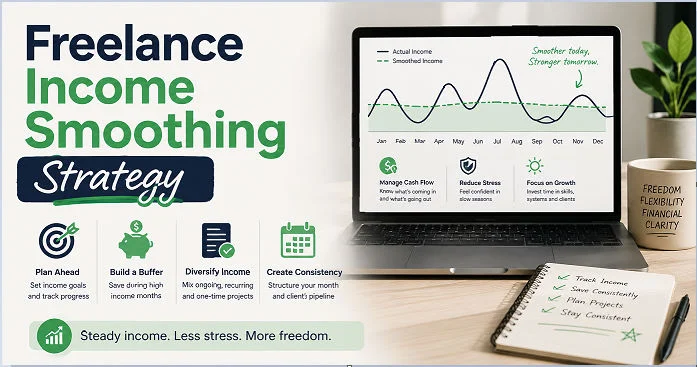
A freelance income smoothing strategy is a systematic financial framework that converts irregular revenue into predictable monthly personal pay. It functions by routing all business revenue into a central retention buffer during high-earning months, allowing you to pay yourself a fixed, reliable salary regardless of immediate market fluctuations.
The Structural Reality of Variable Income
Traditional corporate employees enjoy the psychological safety of a predictable bi-weekly paycheck. Independent business owners, on the other hand, face a constant barrage of variable external factors:
- Pronounced Seasonal Fluctuations: Industry-wide dry spells (like the December corporate hiring freeze or summer slowdowns).
- Delayed Payment Windows: Net-30, Net-60, or even Net-90 payment terms that disrupt immediate cash flow.
- Project-Based Income Curves: Massive upfront deposits followed by months of zero project income during production.
- Unpredicted Client Churn: Sudden budget cuts or strategy pivots on the client’s end that result in canceled retainers.
Without a deliberate income smoothing mechanism, these realities lead to chronic financial stress, reactive spending, and operational burnout.
7 Steps to Implement a Freelance Income Smoothing Strategy
1. Establish a Dedicated Income Buffer Account
The foundation of a reliable freelance income smoothing strategy is a dedicated liquidity buffer. Think of this as an intentional holding tank that sits directly between your business accounts and your personal wallet.
During high-income months, your excess revenue accumulates here. During lean months, you draw from this account to keep your personal lifestyle fully funded.
| Freelancer Experience Level | Target Cash Buffer Size | Strategic Purpose |
| Beginner Freelancer | 1–2 Months of Baseline Expenses | Immediate protection against late client invoices. |
| Established Freelancer | 3–6 Months of Baseline Expenses | Security to navigate client churn or multi-week dry spells. |
| Advanced / Full-Time Soloist | 6–12 Months of Baseline Expenses | Total financial autonomy to turn down low-paying work. |
2. Pay Yourself a Fixed Monthly Personal Salary
Stop treating your business bank account like an open ATM. One of the most transformative mental shifts you can make as a freelancer is to step into the role of your own employee.
- The Process: Route every single inbound client payment into a dedicated business checking account.
- The Action: On a specific day each month (e.g., the 1st or the 15th), execute an automated transfer of a fixed, predetermined dollar amount to your personal checking account.
- The Result: Any surplus cash remains untouched in your business buffer to absorb future shortfalls. This simple routine drastically reduces decision fatigue and eliminates the impulse to overspend after booking a major client contract.
3. Deploy the 70-20-10 Income Allocation Framework
Every dollar that enters your business account needs an immediate, tactical assignment. A highly effective foundational breakdown for a freelance income smoothing strategy is the 70-20-10 allocation rule.
[ Incoming Invoice Gross Revenue ]
├──► 70% Core Operating & Living Expenses
├──► 20% Regulatory Tax Reserve Account
└──► 10% Long-Term Capital Wealth & Savings
While you can modify these specific percentages based on your location and immediate lifestyle overhead, the key is consistency. Automating this split using accounting or banking apps ensures you never accidentally spend your upcoming tax obligations.
4. Run a Rolling 90-Day Cash Flow Forecast
Amateur freelancers only look at the money currently sitting in their bank account. Strategic freelancers look 90 days down the pipeline to spot upcoming financial droughts before they manifest.
To construct an accurate 90-day cash flow forecast, run a weekly review of your pipeline using a simple traffic-light classification system:
- 🟢 Confirmed Revenue: Signed retainers, active milestones, and finalized invoices waiting for payout.
- 🟡 Likely Revenue: Verbal agreements, contract renewals currently in negotiation, or late-stage project proposals.
- 🔴 Speculative Revenue: Early-stage inbound leads, cold outreach responses, or conceptual project expansions.
If your 90-day green light total falls below your required salary threshold, you know exactly when to ramp up your outbound marketing and client acquisition efforts.
Related Posts
5. Intentionally Diversify Your Revenue Architecture
Relying entirely on one or two anchor clients isn’t freelancing—it’s a single-point-of-failure employment situation without benefits. A robust income smoothing framework balances your portfolio across different types of income:
- Retainer Agreements: Securing predictable monthly payments in exchange for dedicated ongoing availability.
- Productized Services: Fixed-scope, fixed-price offers that can be purchased and delivered rapidly without custom quoting.
- Digital Products: E-books, templates, and automated workflows that bring in passive, asynchronous cash flow.
- Consulting & Strategy Audits: High-ticket, short-term engagements that inject large bursts of capital into your core buffer fund.
6. Build a Quad-Account Banking Infrastructure
Mixing business revenues with personal living money is the fastest path to financial disorientation. To gain absolute visibility over your cash flow mechanics, separate your operations into four distinct accounts:
- Business Operational Account (Checking): The primary collection bucket where all client invoices are cleared.
- The Income Buffer Account (High-Yield Savings): Holds your accumulated business reserves, safely earning compound interest until needed.
- The Regulatory Tax Account (High-Yield Savings): A ring-fenced bucket dedicated strictly to local quarterly or annual tax liabilities.
- Personal Spending Account (Checking): Your personal wallet, funded only by your monthly fixed salary transfer.
7. Run the Practical “SMOOTH” Operational Framework™
To maintain long-term financial consistency and protect your mental health from the anxiety of variable income, follow this repeatable process:
- S – Save Surplus Capital: Automatically capture money above your baseline during highly profitable months.
- M – Monitor Cash Flow Metrics: Dedicate 30 minutes every Friday morning to review inbound clearings and outbound business overhead.
- O – Organize Target Accounts: Keep a distinct separation between operational cash, tax liabilities, and personal living money.
- O – Optimize Client Concentrations: Ensure no single client accounts for more than 30% to 40% of your total revenue.
- T – Track Rolling Pipeline Forecasts: Maintain a forward-facing 90-day roadmap of your project backlog.
- H – Hold Secure Reserves: Protect your business longevity by maintaining an emergency fund completely independent of daily operational cash.
📊 Core Cash Buffers vs. Specialized Sinking Funds
An advanced freelance income smoothing strategy recognizes that not all reserves serve the same operational function. Distributing your capital effectively keeps your business safe and your strategy clear.
| Financial Bucket | Primary Strategic Purpose | Target Capital Allocation Goal |
| Core Cash Buffer | Smooths out monthly personal salary variances. | 3 to 6 months of baseline lifestyle expenses. |
| Sinking Funds | Covers predictable, non-monthly business costs (e.g., software renewals, new laptop). | Total annualized cost divided by 12, saved incrementally each month. |
| Tax Regulatory Reserve | Securely holds your projected government tax obligations. | 25% to 35% of every incoming gross invoice. |
| Opportunistic Runway | Funds spontaneous business growth, coaching, or sudden skill-building. | Discretionary allocation from high-earning surpluses. |
Navigating Regional Tax Codes and Compliance
Smoothing out a variable income requires specialized navigation of local tax regulations across major international markets:
🇺🇸 United States
Sole proprietors and single-member LLCs in the US are responsible for self-employment taxes (covering Social Security and Medicare). To avoid automated underpayment penalties from the IRS, you must calculate and submit Estimated Taxes quarterly via the EFTPS portal. Your tax reserve account is critical to preventing cash flow shocks during these specific months.
🇬🇧 United Kingdom
UK-based sole traders must manage annual Self Assessment responsibilities. A major cash flow trap is the “Payments on Account” rule, which requires you to pay half of your estimated next tax bill in advance by January 31st and July 31st. Keeping a continuous 25% to 30% reserve inside your business savings account prevents these HMRC demands from wiping out your lifestyle liquidity.
🇮🇪 Ireland
In Ireland, non-PAYE self-employed workers fall under the self-assessment framework. You must calculate and pay Preliminary Tax by October 31st each year, accounting for 100% of your current year’s liability or 110% of the previous year’s total. Keeping accurate, real-time records via the Revenue Online Service (ROS) ensures your income smoothing metrics match your true legal obligations.
🇨🇦 Canada
Canadian independent contractors must carefully track their gross sales milestones. The moment your taxable revenues clear the $30,000 CAD threshold within any single calendar quarter (or across four consecutive quarters), you are legally required to register for and collect GST/HST. Failing to anticipate this milestone can severely damage an unmonitored cash buffer.
Frequently Asked Questions
Is income smoothing the same thing as setting a personal budget?
No. Budgeting is the process of managing, tracking, and restricting your outbound expenses. Income smoothing is a cash flow management strategy designed to regulate unpredictable inbound revenues, stabilizing the rate at which that money enters your personal lifestyle budget.
What should I do if my cash buffer runs completely dry during a market slump?
If a prolonged market downturn or client loss depletes your cash buffer, temporarily reduce your personal salary payout to your pre-calculated survival baseline budget (covering only core rent, food, and utilities). Use the operational breathing room to reposition your marketing, upgrade high-value technical skills, and prioritize pitching monthly retainer contracts.
Should I keep my core business cash buffer in a standard checking account?
No. Keep your immediate weekly operational funds in a business checking account, but transfer your long-term tax reserves and cash buffer funds into a dedicated High-Yield Savings Accounts (HYSAs). This keeps the capital completely safe and accessible while protecting its purchasing power via compound interest.
How do multi-currency earnings affect an income smoothing strategy?
Earning across multiple global currencies (like USD, EUR, and GBP) exposes you to foreign exchange volatility. To optimize your strategy, utilize multi-currency business platforms such as Wise or Payoneer to collect payments in their native currency. Hold them securely, and convert them to your local home currency only when exchange rates are favorable, minimizing conversion losses.
Conclusion: Take Control of Your Financial Runway
Building a sustainable, long-term freelance career requires more than just delivering exceptional work to your clients; it requires mastering the mechanics of your personal cash flow. Implementing a structured freelance income smoothing strategy eliminates the chronic anxiety of variable income, giving you the clarity to focus on strategic business growth rather than next week’s bills.
Stop letting volatile invoice processing times dictate your personal financial health. Treat your freelancing like the structured, profitable business entity it deserves to be.
[…] For a deeper approach, explore our guide on Freelance Income Smoothing Strategy. […]
[…] home office deduction is one of the most powerful tax-saving […]
[…] an extensive, mathematical breakdown of this concept, review our comprehensive framework on the Freelance Income Smoothing Strategy to permanently insulate your business from market […]
[…] If your income fluctuates significantly month to month, consider implementing a Freelance Income Smoothing Strategy: […]