

You just received a client payment notification. While the immediate dopamine hit of a closed invoice is satisfying, the precise sequence of financial choices you execute over the next 60 minutes dictates your long-term business sustainability far more than the work that generated the revenue.
Most independent operators focus exclusively on top-line client acquisition. However, elite freelancers and digital entrepreneurs prioritize a different financial framework: mastering what to do AFTER money comes in.
Without a systematic capital allocation framework, service providers inevitably fall victim to the “feast-or-famine” cycle—constantly guessing their actual net margins while exposing themselves to catastrophic tax liabilities. If you want to break this cycle, you must treat your personal production like a corporate enterprise.
This comprehensive operational guide details exactly what to do AFTER money comes in, using a structured capital deployment protocol designed to stabilize irregular cash flow, fully automate tax compliance, and maximize long-term wealth accumulation.
The Core Strategy: Direct Answer Box
Operational Protocol: What to Do AFTER Money Comes In
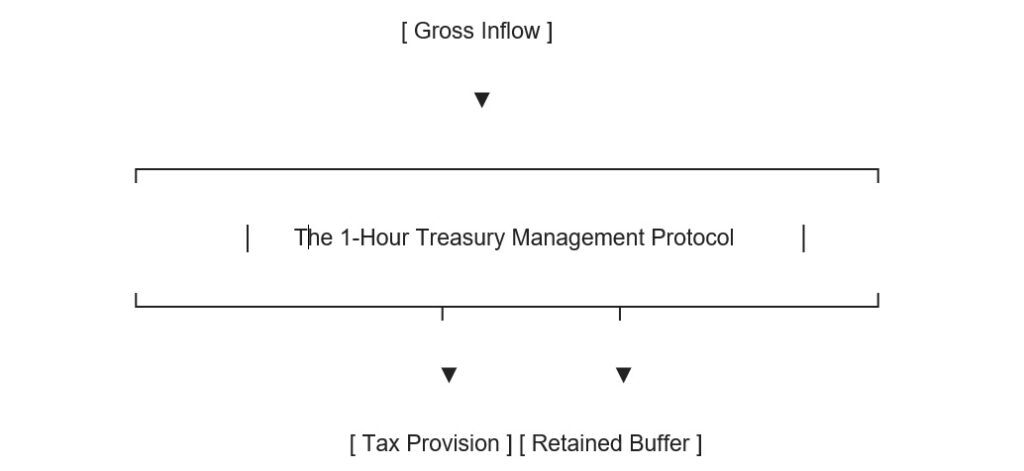
The moment a client payment is processed, you must immediately route gross revenues through a systematic Velocity-Based Cash Flow Allocation rather than leaving funds aggregate in a primary checking account. Execute a mandatory structural partition: allocate 25–30% directly to a dedicated Tax Provision Account, direct 10% to Wealth Accumulation/Retained Earnings, and route the remaining balance to your Operating Ledger to fund your fixed baseline salary and core overhead. This instantly separates your true business liquidity from state tax obligations and operational expenses.
The Fundamental Error: The “Aggregate Balance” Trap
The most common operational vulnerability for freelancers is relying on an aggregate bank balance to determine purchasing power. You look at your primary business account, see a clean balance of $5,000, and make immediate corporate or personal purchase decisions based on that single data point.
This is an operational illusion known as the Aggregate Balance Trap. That $5,000 does not represent disposable cash flow; it contains unallocated liabilities:
- The Government’s Share: Approximately 25–35% is pre-tax liability owed to federal, state, or regional revenue services.
- Working Capital Reserves: A percentage belongs to your future self to cover operational overhead during predictable low-velocity or dry months.
Leaving unpartitioned capital in a standard business checking account artificially inflates your perceived purchasing power, skewing your risk calculations and leading to systemic overspending. To mitigate this risk, you must transition to an automated cash allocation architecture.
The 5-Step “P.A.R.T.S.” Treasury Protocol
This standardized operating procedure defines exactly what to do AFTER money comes in to protect your margins and build permanent corporate liquidity.
1. P – Partition Liabilities (Tax Provisioning)
Never treat gross income as spendable revenue. The moment an invoice settles via your payment gateway, immediately transfer 25% to 30% into a ring-fenced, high-yield Tax Provision Account.
Merchant processors like PayPal, Stripe, and Airwallex automatically issue tax documentation (such as Form 1099-K in the United States) directly to revenue agencies. Failing to isolate these funds immediately means you are effectively borrowing high-interest capital from your future tax liabilities. Label this account “Tax Liabilities – Non-Operational” to visually enforce cognitive scarcity.
2. A – Apply Allocation Percentages (The Reverse Margin Method)
Traditional accounting relies on the flawed linear formula: Sales−Expenses=Profit. This methodology encourages operators to scale expenses to match gross inflows. Instead, implement a reverse-engineered corporate allocation protocol:
Sales−Profit=Expenses
Before paying out a single operational invoice, split your remaining net inflows according to rigid, predefined target allocation percentages:
- Capital Preservation & Wealth (10%): Transferred automatically to an aggregate investment vehicle or long-term treasury reserve.
- Owner’s Compensation / Salary (50%): The dedicated pool used to pay your consistent, predictable baseline personal salary.
- Tax Provisioning (25%–30%): Kept separate as calculated in Step 1.
- Operating Ledger (10%–15%): The maximum allowable capital for software-as-a-service (SaaS) subscriptions, infrastructure, and marketing tools.
If your core operating costs regularly breach 15% of your gross intake, your business model suffers from structural inefficiencies: either your pricing tiers are unsustainably low, or your operational overhead is over-leveraged.
3. R – Restrict Impulse Outflows (The Capital Lag Rule)
Rapid scaling or unexpected windfall revenue often causes lifestyle or operational creep. To maintain strict control over cash velocity, enforce a mandatory Capital Lag Rule for any non-recurring expense exceeding a set threshold (e.g., $100 USD or equivalent regional value).
| Asset/Expense Classification | Immediate Action Protocol | Mandatory Retain Time |
| Critical Infrastructure (Rent, Core SaaS, Hosting) | Execute immediately from Operating Ledger | 0 Days |
| Growth Capital Outlays (Training Programs, Hardware) | Route to Pending Ledger for technical evaluation | 7 Days |
| Discretionary Enhancements (Aesthetic workspace updates) | Route to Pending Ledger for variance analysis | 14 Days |
4. T – Transition Surplus to a Dynamic Income Buffer
To build an enduring business, you must decoupled your monthly personal income from your erratic monthly sales volumes. This is called Income Smoothing.
Establish an Income Buffer Account held at a separate banking institution. During peak-performance months, any cash generated beyond your fixed 50% Owner’s Compensation target is left untouched in the Buffer. During low-velocity quarters, you do not decrease your personal pay; instead, you systematically draw the deficit directly from this accumulated buffer, ensuring an unchanging personal financial baseline.
For an extensive, mathematical breakdown of this concept, review our comprehensive framework on the Freelance Income Smoothing Strategy to permanently insulate your business from market volatility.
5. S – Sweep and Log Transaction Processing Fees
A massive amount of operational tax write-offs are lost simply due to poor accounting hygiene at the point of transaction. Processing fees levied by Stripe, PayPal, or international wire providers are fully deductible corporate business expenses.
When a $1,000 invoice settles, and you receive $960 after a $40 payment processing fee, do not document your gross revenue as $960. You must log the full $1,000 as gross income and immediately capture the $40 merchant deduction inside your accounting engine. Run a weekly or monthly transaction sweep to pull these platform fee logs directly into your deductions archive before they get buried in your payment gateway dashboards.
To ensure absolute compliance and maximum write-offs, study our dedicated deep dive into tracking PayPal Taxes for Freelancers to protect your net profitability.

Advanced Architecture: The Velocity Buffer Formula
Generic personal finance blogs often suggest saving a blanket “3 to 6 months of living expenses.” For professional digital entrepreneurs and cross-border freelancers, this advice lacks the necessary nuance required for variable risk profiles.
Your required working capital reserves should scale dynamically based on your client concentration levels, location-specific operational costs, and client replacement velocity.
Required Working Capital Buffer=4Monthly Operational Overhead×Weeks to Replace Primary Client
Case Study A: Highly Diversified Operator (US-Based)
- Monthly Core Overhead: $4,000
- Client Concentration: Low (10 independent clients contributing equally)
- Time to Replace a Client Account: 4 weeks
- Calculation:
4$4,000×4=$4,000 Minimum Cash Buffer Required
Case Study B: High-Risk Single-Source Operator (Ireland-Based)
- Monthly Core Overhead: €5,000
- Client Concentration: Extremely High (2 enterprise clients accounting for 100% of revenue)
- Time to Replace a Client Account: 12 weeks due to formal enterprise procurement timelines
- Calculation:
4€5,000×12=€15,000 Minimum Cash Buffer Required
Jurisdictional Compliance and Localized Tax Logic
Knowing what to do AFTER money comes in requires a firm grasp of your local geographic tax rules. Capital allocation changes significantly based on where your corporate entity is officially registered.
🇺🇸 United States (Internal Revenue Service – IRS)
Independent contractors must submit Quarterly Estimated Tax Payments using Form 1040-ES in April, June, September, and January. Ensure your Tax Provision Account reserves enough capital to comfortably absorb the standard 15.3% Self-Employment Tax (covering FICA: Social Security and Medicare) in addition to your progressive federal and state income tax brackets.
🇬🇧 United Kingdom (HM Revenue & Customs – HMRC)
Sole traders face a unique cash flow hurdle known as Payments on Account. These are advance payments toward your next tax bill, calculated as half of your previous year’s total bill, and are strictly due on January 31st and July 31st. Because of this dual-payment cycle, your isolated tax capital must remain liquid and untouched for significantly longer horizons than in other jurisdictions.
🇮🇪 Ireland (Revenue Commissioners)
Self-employed individuals operating under the self-assessment framework must account for Preliminary Tax by October 31st each year. This requirement mandates that you pay 100% of your current year’s estimated tax liability (or 100% of the previous year’s finalized liability) in advance. If you settle large contract invoices late in the calendar year, you must explicitly preserve that capital to meet your upcoming autumn Preliminary Tax demands.
🇨🇦 Canada (Canada Revenue Agency – CRA)
Closely monitor your rolling gross revenues across consecutive quarters. The exact moment your business crosses $30,000 CAD in gross taxable sales within any single calendar year, you face a mandatory requirement to register for a GST/HST account within 30 days. Moving forward, your cash allocation protocol shifts: you must separate the sales tax collected from clients from your core service revenue, as these funds are held entirely in trust for the federal government.
Infrastructure: Automating the Allocation Flow
Relying on human willpower to manually execute cash transfers after every single paid invoice introduces operational friction and a high probability of human error. True financial control relies on building an automated, programmatic money-routing infrastructure.
- Wise Business: Essential infrastructure for international operators and digital nomads. Wise allows you to set up multi-currency local account details (USD, EUR, GBP, AUD) and establish distinct “Jars” to automatically isolate tax allocations before converting capital back to your local currency.
- Wave Accounting / Xero: Automated bank feeds that immediately capture, categorize, and track inbound transactions while auto-matching invoices to mitigate ledger variance.
- You Need a Budget (YNAB): An exceptional zero-based budgeting engine built around assigning clear, functional roles to every single dollar currently residing in your cash reserves.
For an un-sponsored, exhaustive review of accounting architectures, view our tested breakdown of Free Budgeting Apps for Freelancers to optimize your daily accounting stack.
Systemic Comparison: Unstructured vs. Structured Cash Flow
| Operational State: Unstructured Cash Flow (The Aggregate Trap) | Enterprise State: Structured Cash Flow (The P.A.R.T.S. Protocol) |
| A gross payment of $5,000 hits your business account. | A gross payment of $5,000 hits your business account. |
| You pay immediate personal rent or overhead ($2,000). | The system auto-allocates $1,500 directly to Tax Provisioning. |
| You purchase a non-essential hardware upgrade ($1,000). | The system routes $500 to the Capital Preservation Ledger. |
| You observe a remaining balance of $2,000 and mistake it for disposable profit. | The system routes $500 directly to the Operating Expense Account. |
| Tax Deadline Impact: You face an unexpected $1,500 tax bill with zero liquid reserves. 😰 | Tax Deadline Impact: All operational tax liabilities are fully funded, and you draw a predictable, stress-free salary. 😎 |
Strategic Takeaways
- Execute Structural Isolation Instantly: Isolate your core liabilities (Taxes, Profit, and Fixed Reserves) before allowing capital to touch your day-to-day operational accounts.
- Stabilize Through an Income Buffer: Eliminate cash flow volatility by paying yourself a fixed, unvarying corporate salary drawn systematically from a buffer reserve.
- Automate Cash Movements Programmatically: Connect your primary banking lines to robust accounting sub-ledgers to minimize manual transfer dependencies.
- Respect Geographic Regulations: Tailor your cash preservation timelines around regional tax realities like US quarterly payments or UK Payments on Account.
- Capture Platform Overhead Daily: Keep close track of transaction and merchant fees on the day they occur to maximize your valid business tax deductions.
(FAQs): What to Do AFTER Money Comes In
1. What immediate action step should I execute after receiving a client payment via PayPal?
Do not allow client funds to accumulate inside your PayPal merchant dashboard. Move the balance immediately to your primary business checking line. Merchant platforms are payment processors, not licensed banking institutions, and leaving large amounts of capital there exposes you to unexpected account holds or compliance freezes. Apply your structural allocation percentages the very day those funds land in your corporate account.
2. What exact percentage of freelance income must be set aside for tax liabilities?
Maintain a baseline tax provision of 25% to 30% of your gross revenue. In jurisdictions with high local self-employment obligations (such as the US with its 15.3% self-employment contribution), or regions with regional GST/VAT exposure, increase this baseline target to 30%–35% to give your business a safe financial cushion.
3. Should I prioritize paying off high-interest debt or building an income buffer first?
Prioritize building a one-month minimum operational cash buffer before aggressively liquidating business debts. If you direct 100% of your free cash toward debt repayment without holding back a liquid buffer, the next unexpected low-income month or late client invoice will force you to take on expensive new debt to cover your basic living costs.
4. What is the optimal bank account structure for a modern freelance business?
For complete clarity, maintain a minimum of four separate bank accounts:
Account 1: Primary Income Clearing Line (Business Checking)
Account 2: Tax Provision Isolation Ledger (High-Yield Savings)
Account 3: Owner’s Compensation Payroll (Business Checking)
Account 4: Corporate Retained Earnings / Wealth (High-Yield Savings)
5. Am I legally permitted to pay myself a fixed salary if my business account experiences a low-income month?
Yes. Provided your business has accumulated cash reserves within its core Income Buffer or Retained Earnings accounts, drawing a consistent payroll amount during a low-sales month is a perfectly legal and standard corporate finance strategy. This practice forms the foundation of professional income smoothing.
Conclusion
Your business checking account is not a personal wallet. Mastering exactly what to do AFTER money comes in is the key operational milestone that separates struggling, reactive freelancers from highly profitable, sustainable digital entrepreneurs.
The next time a client invoice settles and your payment notifications ring, do not simply view it as disposable spending cash. Isolate your liabilities, respect the P.A.R.T.S. treasury system, and protect your margins. Your business equity—and your peace of mind come next tax season—will thank you.